>
Acanthuriformes (Surgeonfishes) >
Acanthuridae (Surgeonfishes, tangs, unicornfishes) > Acanthurinae
Etymology: Acanthurus: Greek, akantha = thorn + Greek, oura = tail (Ref. 45335); xanthopterus: Name from Greek 'xanthos' for yellow and 'ptero' for fin; referring to the yellow color of the outer part of the pectoral fin (Ref. 37792).
More on author: Valenciennes.
Meio ambiente: milieu / Zona climática / intervalo de profundidade / faixa de distribuição
Ecologia
marinhas associadas(os) a recifes; intervalo de profundidade 1 - 100 m (Ref. 9267), usually 5 - 90 m (Ref. 27115). Tropical; 24°C - 28°C (Ref. 27115); 35°N - 35°S, 23°E - 77°W
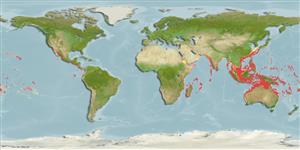
Indo-Pacific: coast of East Africa to the Hawaiian Islands and French Polynesia, north to southern Japan, south to the Great Barrier Reef and New Caledonia. Eastern Pacific: lower Gulf of California and Clipperton Island to Panama and the Galapagos Islands.
Tamanho / Peso / Idade
Maturidade: Lm ? range ? - ? cm
Max length : 70.0 cm TL macho/indeterminado; (Ref. 4795); common length : 50.0 cm TL macho/indeterminado; (Ref. 30573); idade máx. registrada: 34 anos (Ref. 52229)
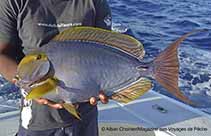
Espinhos dorsais (total) : 8 - 9; Raios dorsais (total) : 25 - 27; Espinhos anais: 3; Raios anais : 23 - 25. Body purplish gray when alive; grayish brown when preserved; a region of dull yellow in front of eye, a lesser extension posterior to lower part of eye; outer 1/3 of pectoral fin yellow, extreme distal part hyaline; dorsal and anal fins yellowish grey basally, dull yellow distally; caudal fin base whitish; caudal fin purplish. Anterior gill rakers 16-24, posterior 17-22. Caudal spine small.
Body shape (shape guide): short and / or deep; Cross section: compressed.
Live in various reef habitats, sand slopes and lagoons (Ref. 48637). Juveniles inhabit shallow, protected, turbid inshore waters while adults prefer deeper areas of protected bays and lagoons. Also in outer reef areas (Ref. 1602). Benthopelagic (Ref. 58302). Schooling species, feed on diatoms, detritus film of sand, filamentous algae, hydroids, and pieces of fish (Ref. 1602, 48637). Probably the only surgeonfish that readily takes bait (Ref. 12484).
Ciclo de vida ou comportamento de acasalamento
Maturidade | Reprodução | Desova | Ovos | Fecundidade | Larvas
Randall, J.E., 1956. A revision of the surgeonfish genus Acanthurus. Pac. Sci. 10(2):159-235. (Ref. 1920)
Status na Lista Vermelha da UICN (Ref. 130435: Version 2025-2 (Global))
Uso pelos humanos
Pescarias: pouco comercial; Aquário: Espécies comerciais
Ferramentas
Relatórios especiais
Baixar XML
Fontes da internet
Estimativas baseadas em modelos
Temperatura preferida (Ref.
123201): 23.3 - 29, mean 27.7 °C (based on 2980 cells).
Índice de diversidade filogenética (Ref.
82804): PD
50 = 0.5000 [Uniqueness, from 0.5 = low to 2.0 = high].
Bayesian length-weight: a=0.02399 (0.02065 - 0.02787), b=2.96 (2.92 - 3.00), in cm total length, based on LWR estimates for this species (Ref.
93245).
Nível Trófico (Ref.
69278): 2.9 ±0.23 se; based on food items.
Generation time: 3.8 ( na - na) years. Estimated as median ln(3)/K based on 1
growth studies.
Resiliência (Ref.
120179): Muito baixo(a), tempo mínimo de duplicação da população maior que 14 anos (K=0.287; tmax=34).
Vulnerabilidade da pesca (Ref.
59153): Moderate vulnerability (37 of 100).
🛈
Nutrientes (Ref.
124155): Calcium = 33.2 [15.3, 112.0] mg/100g; Iron = 0.603 [0.209, 1.707] mg/100g; Protein = 19 [18, 20] %; Omega3 = 0.143 [0.065, 0.314] g/100g; Selenium = 22.5 [7.9, 74.1] μg/100g; VitaminA = 46.5 [18.2, 115.5] μg/100g; Zinc = 2.15 [0.68, 3.89] mg/100g (wet weight);