>
Scombriformes (Mackerels) >
Scombridae (Mackerels, tunas, bonitos) > Scombrinae
Etymology: Scomberomorus: Latin, scomber = mackerel + Greek, moros = silly, stupid (Ref. 45335).
Milieu: milieu / Klimaatzone / Diepte / verspreidingsgebied
Ecologie
marien pelagic-neritic; oceanodroom (Ref. 51243). Tropical; 39°N - 6°S, 70°E - 138°E (Ref. 168)
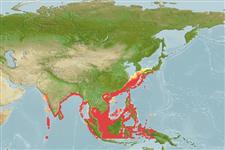
Indo-West Pacific: west coast of India and Sri Lanka along the continental shelf eastward to Sumatra, Indonesia and Singapore, and northward to China, Korea (Ref. 9684) and Wakasa Bay, Sea of Japan. Does not extend past Sumatra in the East Indies (Ref. 9684).
Lengte bij maturiteit / Grootte / Gewicht / Leeftijd
Maturiteit: Lm ?, range 75 - ? cm
Max length : 150 cm FL mannelijk / geslacht onbekend; (Ref. 168); common length : 60.0 cm FL mannelijk / geslacht onbekend; (Ref. 168); max. gepubliceerd gewicht: 15.0 kg (Ref. 168)
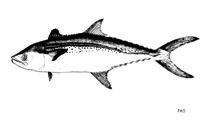
Dorsale stekels (totaal) : 14 - 17; Dorsale zachte stralen (totaal) : 20 - 24; Anale stekels: 0; Anale zachte stralen: 20 - 24; Wervels: 46 - 47. Interpelvic process small and bifid. Lateral line with many auxiliary branches extending dorsally and ventrally in anterior third, gradually curving down toward caudal peduncle. Intestine with 4 folds and 5 limbs. Swim bladder absent. Body covered with small scales. Sides silvery with spots scattered along lateral median line.
Body shape (shape guide): fusiform / normal; Cross section: oval.
Feeds on small schooling fishes, such as sardines and anchovies and on shrimps. This species makes up an important part of the drift net fishery in Palk Bay and the Gulf of Mannar. Marketed fresh and dried-salted (Ref. 9684).
Levenscyclus en paargedrag
Maturiteit | Voortplanting | Paaien | Eieren | Fecunditeit | Larven
Collette, B.B. and C.E. Nauen, 1983. FAO Species Catalogue. Vol. 2. Scombrids of the world. An annotated and illustrated catalogue of tunas, mackerels, bonitos and related species known to date. Rome: FAO. FAO Fish. Synop. 125(2):137 p. (Ref. 168)
Status op de Rode Lijst van het IUCN (Ref. 130435: Version 2025-2 (Global))
Gevaar voor de mens
Harmless
Gebruik door de mens
Visserij: van minder commercieel belang; sportvis: ja
Tools
Speciale rapporten
Download XML
Internetbronnen
Schattingen op basis van modellen
Gewenste temperatuur (Ref.
123201): 20.1 - 28.6, mean 27.3 °C (based on 823 cells).
Fylogenetische diversiteitsindex (Ref.
82804): PD
50 = 0.5000 [Uniqueness, from 0.5 = low to 2.0 = high].
Bayesian length-weight: a=0.00832 (0.00379 - 0.01824), b=3.03 (2.86 - 3.20), in cm total length, based on LWR estimates for this Genus-body shape (Ref.
93245).
Trofisch niveau (Ref.
69278): 4.2 ±0.74 se; based on food items.
Weerstandsvermogen (Ref.
120179): Gemiddeld, minimale populatieverdubbelingstijd 1,4-4,4 jaar (Preliminary K or Fecundity.).
Kwetsbaarheid van de visserij (Ref.
59153): Very high vulnerability (90 of 100).
🛈
Voedingsstoffen (Ref.
124155): Calcium = 22.9 [10.4, 77.5] mg/100g; Iron = 0.727 [0.323, 1.704] mg/100g; Protein = 20.5 [19.2, 21.7] %; Omega3 = 0.232 [0.145, 0.376] g/100g; Selenium = 66.9 [24.4, 208.1] μg/100g; VitaminA = 20.3 [5.1, 90.6] μg/100g; Zinc = 0.639 [0.423, 1.017] mg/100g (wet weight);