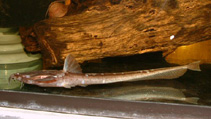
>
Siluriformes (Catfishes) >
Aspredinidae (Banjo catfishes) > Aspredininae
Etymology: Platystacus: Greek, platys = flat, broad + Latin, acus = needle (Ref. 45335).
More on author: Bloch.
Taxonomic Remarks
See Mees (1987: 186) for detailed description. Friel (1994: 86) removed this species from Aspredo to preserve monophyly of that genus.
Ambiente: milieu / zona climatica / distribuzione batimetrica / gamma di distribuzione
Ecologia
; acqua dolce; salmastro demersale; pH range: 6.8 - 8.2; dH range: 12 - 35. Tropical; 22°C - 25°C (Ref. 2060)
Central and South America: Venezuela to northern Brazil (including the lower portions of coastal rivers).
Dimensione / Peso / Età
Maturità: Lm ? range ? - ? cm
Max length : 31.8 cm SL maschio/sesso non determinato; (Ref. 36695); common length : 15.0 cm TL maschio/sesso non determinato; (Ref. 5217)
Occurs mainly in brackish water. Found on soft bottoms of shallow turbid water near river mouths. Reported to migrate from estuary into freshwater, but actual spawning apparently takes place in brackish water (Ref. 6868). The species has a peculiar mode of egg incubation wherein the female banjo catfish carries the eggs firmly attached to the underside of the body. This seems to be an adaptation to facilitate the oxygenation of the eggs in muddy environments. Reproduction probably occurs during the earlier part of the year (Ref. 35381).
Ciclo vitale e comportamento di accoppiamento
Maturità | Riproduzione | Deposizione | Uova | Fecondità | Larve
Females carry their eggs and young attached to the ventral surface of the body.
Friel, J.P., 2003. Aspredinidae (Banjo catfishes). p. 261-267. In R.E. Reis, S.O. Kullander and C.J. Ferraris, Jr. (eds.) Checklist of the Freshwater Fishes of South and Central America. Porto Alegre: EDIPUCRS, Brasil. (Ref. 36695)
Stato della Lista Rossa IUCN (Ref. 130435: Version 2025-2 (Global))
Minaccia per l'uomo
Harmless
Usi umani
Pesca: di nessun interesse; Acquario: Commerciale
Strumenti
Rapporti speciali
Scarica XML
Fonti Internet
Stime basate su modelli
Indice di diversità filogenetica (Fonte Biblio.
82804): PD
50 = 1.0000 [Uniqueness, from 0.5 = low to 2.0 = high].
Bayesian length-weight: a=0.00269 (0.00131 - 0.00552), b=3.01 (2.83 - 3.19), in cm total length, based on LWR estimates for this species & (Sub)family-body (Ref.
93245).
Livello trofico (Fonte Biblio.
69278): 3.2 ±0.4 se; based on size and trophs of closest relatives
Vulnerabilità della pesca (Ref.
59153): Low to moderate vulnerability (29 of 100).
🛈