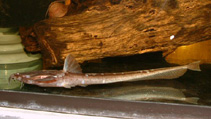
>
Siluriformes (Catfishes) >
Aspredinidae (Banjo catfishes) > Aspredininae
Etymology: Platystacus: Greek, platys = flat, broad + Latin, acus = needle (Ref. 45335).
More on author: Bloch.
Taxonomic Remarks
See Mees (1987: 186) for detailed description. Friel (1994: 86) removed this species from Aspredo to preserve monophyly of that genus.
Environnement : milieu / zone climatique / profondeur / gamme de distribution
Écologie
; eau douce; saumâtre démersal; pH range: 6.8 - 8.2; dH range: 12 - 35. Tropical; 22°C - 25°C (Ref. 2060)
Central and South America: Venezuela to northern Brazil (including the lower portions of coastal rivers).
Taille / Poids / Âge
Maturité: Lm ? range ? - ? cm
Max length : 31.8 cm SL mâle / non sexé; (Ref. 36695); common length : 15.0 cm TL mâle / non sexé; (Ref. 5217)
Occurs mainly in brackish water. Found on soft bottoms of shallow turbid water near river mouths. Reported to migrate from estuary into freshwater, but actual spawning apparently takes place in brackish water (Ref. 6868). The species has a peculiar mode of egg incubation wherein the female banjo catfish carries the eggs firmly attached to the underside of the body. This seems to be an adaptation to facilitate the oxygenation of the eggs in muddy environments. Reproduction probably occurs during the earlier part of the year (Ref. 35381).
Cycle de vie et comportement reproducteur
Maturité | Reproduction | Frai | Œufs | Fécondité | Larves
Females carry their eggs and young attached to the ventral surface of the body.
Friel, J.P., 2003. Aspredinidae (Banjo catfishes). p. 261-267. In R.E. Reis, S.O. Kullander and C.J. Ferraris, Jr. (eds.) Checklist of the Freshwater Fishes of South and Central America. Porto Alegre: EDIPUCRS, Brasil. (Ref. 36695)
Statut dans la liste rouge de l'IUCN (Ref. 130435: Version 2025-2 (Global))
Menace pour l'homme
Harmless
Utilisations par l'homme
Pêcheries: sans intérêt; Aquarium: Commercial
Outils
Articles particuliers
Télécharger en XML
Sources Internet
Estimations basées sur des modèles
Indice de diversité phylogénétique (Réf.
82804): PD
50 = 1.0000 [Uniqueness, from 0.5 = low to 2.0 = high].
Bayesian length-weight: a=0.00269 (0.00131 - 0.00552), b=3.01 (2.83 - 3.19), in cm total length, based on LWR estimates for this species & (Sub)family-body (Ref.
93245).
Niveau trophique (Réf.
69278): 3.2 ±0.4 se; based on size and trophs of closest relatives
Vulnérabilité de la pêche (Ref.
59153): Low to moderate vulnerability (29 of 100).
🛈