>
Ovalentaria/misc (Various families in series Ovalentaria) >
Pomacentridae (Damselfishes) > Chrominae
Etymology: Azurina: Latin, azurinus = blue, pale blue; the name of Leuciscus caeruleus, blue Roach; 1600 (Ref. 45335).
Môi trường: môi trường / vùng khí hậu / Mức độ sâu / phạm vi phân phối
Sinh thái học
biển cùng sống ở rạn san hô; không di cư; mức độ sâu 5 - 30 m (Ref. 28023). Tropical; 1°N - 1°S
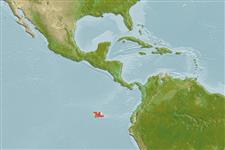
Eastern Central Pacific: Cocos and the Galapagos Islands. This species has not been seen since the 1982/83 El Niño event (Ref. 27438).
Bộ gần gũi / Khối lượng (Trọng lượng) / Tuổi
Chín muồi sinh dục: Lm ? range ? - ? cm
Max length : 15.0 cm SL con đực/không giới tính; (Ref. 28023)
Mô tả ngắn gọn
Khóa để định loại | Hình thái học | Sinh trắc học
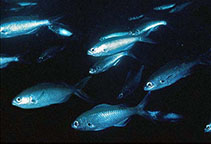
Các tia vây lưng cứng (tổng cộng) : 13; Các vây lưng mềm (tổng cộng) : 10 - 11; Tia cứng vây hậu môn: 2; Tia mềm vây hậu môn: 11 - 12. Color olive-gray with a light-blue tint, silver on the ventral side; snout dusky, a black spot at pectoral fin base; pale gray pelvic and anal fins, dusky dorsal fin. Body more slender compared to other Galápagos damselfish. Preorbital bone smooth without a notchlike projection; edge of preopercle irregular, weakly serrate. Lateral line complete and conspicuous (Ref. 28023).
Body shape (shape guide): fusiform / normal; Cross section: oval.
Apparently this species prefers open water near drop-offs, although individuals are found in a variety of inshore habitats to depths of 30 meters. It is not a common species and resident aggregations have strong preferences for specific sites. Feeds mainly on plankton in the water column, usually in heterotypic aggregations with Chromis atrilobata. Oviparous, distinct pairing during breeding (Ref. 205). Eggs are demersal and adhere to the substrate (Ref. 205). Males guard and aerate the eggs (Ref. 205). Prior to the 1982-83 El Niño, a small aggregation frequented the shallow water just west of Pinnacle Rock at Bartolomé. But despite intensive observations during the decade after this event, no records of this species were made (Ref. 28023).
Vòng đời và hành vi giao phối
Chín muồi sinh dục | Sự tái sinh sản | Đẻ trứng | Các trứng | Sự sinh sản | Ấu trùng
Oviparous, distinct pairing during breeding (Ref. 205). Eggs are demersal and adhere to the substrate (Ref. 205). Males guard and aerate the eggs (Ref. 205).
Grove, J.S. and R.J. Lavenberg, 1997. The fishes of the Galápagos Islands. Stanford University Press, Stanford, 863 p. (Ref. 28023)
Tình trạng Sách đỏ IUCN (Ref. 130435: Version 2025-2 (Global))
Mối đe dọa đối với con người
Harmless
Sử dụng của con người
Các công cụ
Báo cáo đặc biệt
Tải xuống XML
Các nguồn internet
Ước tính dựa trên mô hình
Nhiệt độ ưa thích (Tài liệu tham khảo
123201): 23.7 - 24.5, mean 23.9 °C (based on 9 cells).
Chỉ số đa dạng phát sinh loài (Tài liệu tham khảo
82804): PD
50 = 0.5010 [Uniqueness, from 0.5 = low to 2.0 = high].
Bayesian length-weight: a=0.01259 (0.00569 - 0.02786), b=3.03 (2.84 - 3.22), in cm total length, based on LWR estimates for this (Sub)family-body shape (Ref.
93245).
Mức dinh dưỡng (Tài liệu tham khảo
69278): 3.4 ±0.45 se; based on food items.
Thích nghi nhanh (Tài liệu tham khảo
120179): Trung bình, thời gian nhân đôi của chủng quần tối thiểu là 1.4 - 4.4 năm (Preliminary K or Fecundity.).
Sự dễ bị tổn thương của nghề đánh cá (Ref.
59153): Low vulnerability (10 of 100).
🛈