>
Ovalentaria/misc (Various families in series Ovalentaria) >
Pomacentridae (Damselfishes) > Chrominae
Etymology: Azurina: Latin, azurinus = blue, pale blue; the name of Leuciscus caeruleus, blue Roach; 1600 (Ref. 45335).
Umwelt: Milieu / Klimazone / Tiefenbereich / Verbreitungsgebiet
Ökologie
seewasser riff-verbunden; standorttreu; tiefenbereich 5 - 30 m (Ref. 28023). Tropical; 1°N - 1°S
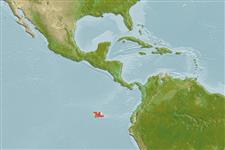
Eastern Central Pacific: Cocos and the Galapagos Islands. This species has not been seen since the 1982/83 El Niño event (Ref. 27438).
Größe / Gewicht / Alter
Geschlechtsreife: Lm ? range ? - ? cm
Max length : 15.0 cm SL Männchen/unbestimmt; (Ref. 28023)
Kurzbeschreibung
Bestimmungsschlüssel | Morphologie | Morphometrie
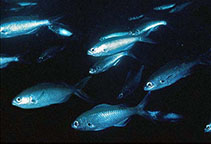
Rückenflossenstacheln (insgesamt) : 13; Rückenflossenweichstrahlen (insgesamt) : 10 - 11; Afterflossenstacheln: 2; Afterflossenweichstrahlen: 11 - 12. Color olive-gray with a light-blue tint, silver on the ventral side; snout dusky, a black spot at pectoral fin base; pale gray pelvic and anal fins, dusky dorsal fin. Body more slender compared to other Galápagos damselfish. Preorbital bone smooth without a notchlike projection; edge of preopercle irregular, weakly serrate. Lateral line complete and conspicuous (Ref. 28023).
Body shape (shape guide): fusiform / normal; Cross section: oval.
Apparently this species prefers open water near drop-offs, although individuals are found in a variety of inshore habitats to depths of 30 meters. It is not a common species and resident aggregations have strong preferences for specific sites. Feeds mainly on plankton in the water column, usually in heterotypic aggregations with Chromis atrilobata. Oviparous, distinct pairing during breeding (Ref. 205). Eggs are demersal and adhere to the substrate (Ref. 205). Males guard and aerate the eggs (Ref. 205). Prior to the 1982-83 El Niño, a small aggregation frequented the shallow water just west of Pinnacle Rock at Bartolomé. But despite intensive observations during the decade after this event, no records of this species were made (Ref. 28023).
Lebenszyklus und Paarungsverhalten
Geschlechtsreife | Fortpflanzung | Ablaichen | Eier | Fruchtbarkeit | Larven
Oviparous, distinct pairing during breeding (Ref. 205). Eggs are demersal and adhere to the substrate (Ref. 205). Males guard and aerate the eggs (Ref. 205).
Grove, J.S. and R.J. Lavenberg, 1997. The fishes of the Galápagos Islands. Stanford University Press, Stanford, 863 p. (Ref. 28023)
IUCN Rote Liste Status (Ref. 130435: Version 2025-2 (Global))
Bedrohung für Menschen
Harmless
Nutzung durch Menschen
Tools
Zusatzinformationen
Download XML
Internet Quellen
Schätzungen auf der Grundlage von Modellen
Bevorzugte Temperatur (Ref.
123201): 23.7 - 24.5, mean 23.9 °C (based on 9 cells).
Phylogenetischer Diversitätsindex (Ref.
82804): PD
50 = 0.5010 [Uniqueness, from 0.5 = low to 2.0 = high].
Bayesian length-weight: a=0.01259 (0.00569 - 0.02786), b=3.03 (2.84 - 3.22), in cm total length, based on LWR estimates for this (Sub)family-body shape (Ref.
93245).
Trophische Ebene (Ref.
69278): 3.4 ±0.45 se; based on food items.
Widerstandsfähigkeit (Ref.
120179): mittel, Verdopplung der Population dauert 1,4 - 4,4 Jahre. (Preliminary K or Fecundity.).
Anfälligkeit der Fischerei (Ref.
59153): Low vulnerability (10 of 100).
🛈