Taxonomic Remarks
There has been much confusion in the past literature between the names Chrysophrys aurata/us, Pagrus aurata/us and Sparus aurata/us, that were used for two different species: Sparus aurata Linnaeus, 1758 from the Northeast and Central Atlantic, Pagrus auratus (Forster, 1801) from the West Pacific on one other side on the other side. Check the geographic origin of specimens when these names are used in the literature.
Miljö: miljö / Klimatzon / djupintervall / distributionsområde
Ekologi
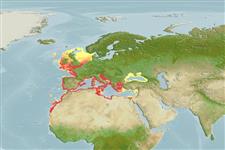
marina; brackvatten bottenlevande; djupintervall 1 - 150 m (Ref. 35388), usually 1 - 30 m (Ref. 54890). Subtropical; 62°N - 15°N, 17°W - 43°E (Ref. 54890)
Eastern Atlantic: British Isles, Strait of Gibraltar to Cape Verde and around the Canary Islands; also in the Mediterranean (Ref. 3688). Reported from the Black Sea (Ref. 12781). Reports from New Zealand refer to Pagrus auratus (Foster 1801) (Ref. 5755, 9258).
Längd vid första mognad / Storlek / Vikt / Ålder
Könsmognad: Lm 36.5, range 33 - 40 cm
Max length : 70.0 cm TL hane/ej könsbestämd; (Ref. 35388); common length : 35.0 cm SL hane/ej könsbestämd; (Ref. 4781); publicerad maxvikt: 17.2 kg (Ref. 40637); rapporterad maxålder: 14 år (Ref. 138174)
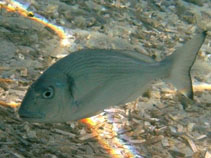
Taggstrålar i ryggfenan (totalt) : 11; Mjukstrålar i ryggfenan (totalt) : 13 - 14; Taggstrålar i analfenan: 3; Mjukstrålar i analfenan: 11 - 12. Body tall, with large black spot on the gill cover. Snout more than twice as long as the eye diameter (Ref. 35388).
Body shape (shape guide): fusiform / normal.
Found in seagrass beds and sandy bottoms as well as in the surf zone commonly to depths of about 30 m, but adults may occur to 150 m depth. A sedentary fish, either solitary or in small aggregations. In spring, they often occur in brackish water coastal lagoons and estuaries. Mainly carnivorous, accessorily herbivorous (Ref. 3688). Feed on shellfish, including mussels and oysters. One of the most important fishes in saline and hypersaline aquaculture. Utilized fresh and eaten steamed, pan-fried, broiled, boiled, microwaved and baked (Ref. 9987).
Males become females at about 3 years of age (Ref. 2715, 28504). Protandric hermaphrodite species, maturing first as male (during the first or second year of age) and after the second or third year of age, as female. Spawning happens generally from October to December, with sequenced spawning during the whole period. Incubation lasts about 2 days at 16-1 7°C. Larval stages last about 50 days at 1 7.5°C or about 43
days at 20°C. Egg size 0.9-1.1 mm, larval length at hatching 2.5-3.0 mm. Simultaneous hermaphroditism is suggested for this species (Ref. 103751).
Bauchot, M.-L. and J.-C. Hureau, 1990. Sparidae. p. 790-812. In J.C. Quero, J.C. Hureau, C. Karrer, A. Post and L. Saldanha (eds.) Check-list of the fishes of the eastern tropical Atlantic (CLOFETA). JNICT, Lisbon; SEI, Paris; and UNESCO, Paris. Vol. 2. (Ref. 3688)
Status på IUCN:s rödlista (Ref. 130435: Version 2025-2 (Global))
Hot mot människor
Harmless
Mänskliga användningsområden
Fiskeri: kommersiell; Vattenbruk: kommersiell; sportfisk: ja
Verktyg
Särskilda rapporter
Ladda ner XML
Internet-källor
Uppskattningar baserade på modeller
Önskad temperatur (Ref.
123201): 12.1 - 21, mean 17.8 °C (based on 258 cells).
Index för fylogenetisk mångfald (Ref.
82804): PD
50 = 1.0000 [Uniqueness, from 0.5 = low to 2.0 = high].
Bayesian length-weight: a=0.01202 (0.01089 - 0.01328), b=3.02 (2.99 - 3.05), in cm total length, based on LWR estimates for this species (Ref.
93245).
Trofisk nivå (Ref.
69278): 3.7 ±0.0 se; based on diet studies.
Generation time: 4.2 (3.0 - 8.5) years. Estimated as median ln(3)/K based on 11
growth studies.
Resiliens (Ref.
120179): Mellan, lägsta populationsfördubblingstid 1,4-4,4 år (K=0.28; tmax=11; tm=2-3).
Prior r = 0.57, 95% CL = 0.37 - 0.85, Based on 7 data-limited stock assessments.
Sårbarhet i fisket (Ref.
59153): Low to moderate vulnerability (35 of 100).
🛈
Sårbarhet för klimatet (Ref.
125649): Moderate vulnerability (41 of 100).
🛈
Näringsämnen (Ref.
124155): Calcium = 63.3 [38.3, 117.5] mg/100g; Iron = 1.03 [0.59, 1.80] mg/100g; Protein = 20.2 [19.2, 21.3] %; Omega3 = 0.655 [0.431, 1.017] g/100g; Selenium = 2 [1, 6] μg/100g; VitaminA = 9.74 [2.44, 37.29] μg/100g; Zinc = 0.315 [0.167, 1.197] mg/100g (wet weight); based on
nutrient studies.