Taxonomic Remarks
There has been much confusion in the past literature between the names Chrysophrys aurata/us, Pagrus aurata/us and Sparus aurata/us, that were used for two different species: Sparus aurata Linnaeus, 1758 from the Northeast and Central Atlantic, Pagrus auratus (Forster, 1801) from the West Pacific on one other side on the other side. Check the geographic origin of specimens when these names are used in the literature.
محیط زیست: محیط زیست / منطقه آب و هوایی / تغييرات عمق / محدوده توزیع
بوم شناسي
دريايي; لب شور نزديك كف زي; تغييرات عمق 1 - 150 m (Ref. 35388), usually 1 - 30 m (Ref. 54890). Subtropical; 62°N - 15°N, 17°W - 43°E (Ref. 54890)
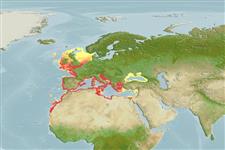
Eastern Atlantic: British Isles, Strait of Gibraltar to Cape Verde and around the Canary Islands; also in the Mediterranean (Ref. 3688). Reported from the Black Sea (Ref. 12781). Reports from New Zealand refer to Pagrus auratus (Foster 1801) (Ref. 5755, 9258).
طول در اولین بلوغ / اندازه / وزن / سن
بلوغ: Lm 36.5, range 33 - 40 cm
Max length : 70.0 cm TL جنس نر / بدون خواص جنسي; (Ref. 35388); common length : 35.0 cm SL جنس نر / بدون خواص جنسي; (Ref. 4781); بيشينه وزن گزارش شده: 17.2 kg (Ref. 40637); بيشينه سن گزارش شده: 14 سال ها (Ref. 138174)
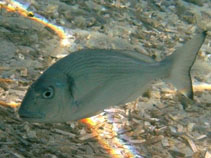
خارهاي باله پشتي (کل) : 11; شعاع نرم باله پشتي (کل) : 13 - 14; خارهاي باله مخرجي: 3; شعاع نرم باله مخرجي: 11 - 12. Body tall, with large black spot on the gill cover. Snout more than twice as long as the eye diameter (Ref. 35388).
Body shape (shape guide): fusiform / normal.
Found in seagrass beds and sandy bottoms as well as in the surf zone commonly to depths of about 30 m, but adults may occur to 150 m depth. A sedentary fish, either solitary or in small aggregations. In spring, they often occur in brackish water coastal lagoons and estuaries. Mainly carnivorous, accessorily herbivorous (Ref. 3688). Feed on shellfish, including mussels and oysters. One of the most important fishes in saline and hypersaline aquaculture. Utilized fresh and eaten steamed, pan-fried, broiled, boiled, microwaved and baked (Ref. 9987).
Males become females at about 3 years of age (Ref. 2715, 28504). Protandric hermaphrodite species, maturing first as male (during the first or second year of age) and after the second or third year of age, as female. Spawning happens generally from October to December, with sequenced spawning during the whole period. Incubation lasts about 2 days at 16-1 7°C. Larval stages last about 50 days at 1 7.5°C or about 43
days at 20°C. Egg size 0.9-1.1 mm, larval length at hatching 2.5-3.0 mm. Simultaneous hermaphroditism is suggested for this species (Ref. 103751).
Bauchot, M.-L. and J.-C. Hureau, 1990. Sparidae. p. 790-812. In J.C. Quero, J.C. Hureau, C. Karrer, A. Post and L. Saldanha (eds.) Check-list of the fishes of the eastern tropical Atlantic (CLOFETA). JNICT, Lisbon; SEI, Paris; and UNESCO, Paris. Vol. 2. (Ref. 3688)
وضعيت در فهرست قرمز IUCN (Ref. 130435: Version 2025-2 (Global))
خطر برای انسان ها
Harmless
استفاده انسانی
ماهي گيري – شيلات: تجاري; آبزي پروري: تجاري; ماهي ها ي سرگرم كننده: بله
ابزارها
گزارش های ويژه
بارگيری XML
منابع اينترنتي
تخمینها بر اساس مدلها
دمای ترجیحی (مرجع
123201): 12.1 - 21, mean 17.8 °C (based on 258 cells).
شاخص تنوع فیلوژنتیکی (مرجع
82804): PD
50 = 1.0000 [Uniqueness, from 0.5 = low to 2.0 = high].
Bayesian length-weight: a=0.01202 (0.01089 - 0.01328), b=3.02 (2.99 - 3.05), in cm total length, based on LWR estimates for this species (Ref.
93245).
سطح تروفیک (مرجع
69278): 3.7 ±0.0 se; based on diet studies.
Generation time: 4.2 (3.0 - 8.5) years. Estimated as median ln(3)/K based on 11
growth studies.
جهندگی (مرجع
120179): متوسط, كمينه زمان لازم براي دو برابر شدن جمعيت 4/1 – 4/4 سال (K=0.28; tmax=11; tm=2-3).
Prior r = 0.57, 95% CL = 0.37 - 0.85, Based on 7 data-limited stock assessments.
آسیبپذیری ماهیگیری (Ref.
59153): Low to moderate vulnerability (35 of 100).
🛈
آسیبپذیری اقلیمی (Ref.
125649): Moderate vulnerability (41 of 100).
🛈
مواد مغذی (Ref.
124155): Calcium = 63.3 [38.3, 117.5] mg/100g; Iron = 1.03 [0.59, 1.80] mg/100g; Protein = 20.2 [19.2, 21.3] %; Omega3 = 0.655 [0.431, 1.017] g/100g; Selenium = 2 [1, 6] μg/100g; VitaminA = 9.74 [2.44, 37.29] μg/100g; Zinc = 0.315 [0.167, 1.197] mg/100g (wet weight); based on
nutrient studies.