>
Scombriformes (Mackerels) >
Scombridae (Mackerels, tunas, bonitos) > Scombrinae
Etymology: Sarda: Latin and Greek, sarda = sardine; name related to the island of Sardinia (Ref. 45335).
More on author: Macleay.
Milieu: milieu / Klimaatzone / Diepte / verspreidingsgebied
Ecologie
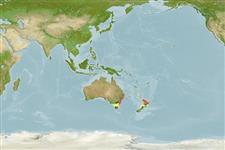
marien pelagic-neritic; oceanodroom (Ref. 51243). Subtropical; 23°S - 48°S, 141°E - 180°E (Ref. 168)
Southwest Pacific: southeastern Australia, Norfolk Island and New Zealand.
Grootte / Gewicht / Leeftijd
Maturiteit: Lm ? range ? - ? cm
Max length : 180 cm FL mannelijk / geslacht onbekend; (Ref. 40637); common length : 45.0 cm FL mannelijk / geslacht onbekend; (Ref. 168); max. gepubliceerd gewicht: 9.4 kg (Ref. 168)
Korte beschrijving
Determinatiesleutels | Morfologie | Morfometrie
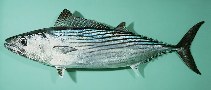
Dorsale stekels (totaal) : 17 - 19; Dorsale zachte stralen (totaal) : 13 - 18; Anale stekels: 0; Anale zachte stralen: 14 - 17; Wervels: 45 - 46. Mouth moderately large. Interpelvic process small and bifid. Swim bladder absent. Laminae of olfactory rosette 21 to 39. Spleen large and prominent in lateral view. Liver with elongate left and right lobes and a short middle lobe. Body completely covered with very small scales posterior to the corselet. Dorsal stripe closer to being horizontal than in other species of Sarda and extending up to the belly in some specimens.
Body shape (shape guide): fusiform / normal; Cross section: oval.
Schooling by size and maturing from January through April. Flesh is light-colored of delicate flavor and good canning quality.
Levenscyclus en paargedrag
Maturiteit | Voortplanting | Paaien | Eieren | Fecunditeit | Larven
Collette, B.B. and C.E. Nauen, 1983. FAO Species Catalogue. Vol. 2. Scombrids of the world. An annotated and illustrated catalogue of tunas, mackerels, bonitos and related species known to date. Rome: FAO. FAO Fish. Synop. 125(2):137 p. (Ref. 168)
Status op de Rode Lijst van het IUCN (Ref. 130435: Version 2025-2 (Global))
Gevaar voor de mens
Harmless
Gebruik door de mens
Visserij: van minder commercieel belang; sportvis: ja; aas: usually
Tools
Speciale rapporten
Download XML
Internetbronnen
Schattingen op basis van modellen
Gewenste temperatuur (Ref.
123201): 13.9 - 19.7, mean 14.9 °C (based on 107 cells).
Fylogenetische diversiteitsindex (Ref.
82804): PD
50 = 0.5312 [Uniqueness, from 0.5 = low to 2.0 = high].
Bayesian length-weight: a=0.00955 (0.00458 - 0.01993), b=3.06 (2.89 - 3.23), in cm total length, based on LWR estimates for this (Sub)family-body shape (Ref.
93245).
Trofisch niveau (Ref.
69278): 4.5 ±0.80 se; based on food items.
Weerstandsvermogen (Ref.
120179): laag, minimale populatieverdubbelingstijd 4,5-14 jaar (Preliminary K or Fecundity.).
Kwetsbaarheid van de visserij (Ref.
59153): Very high vulnerability (90 of 100).
🛈
Voedingsstoffen (Ref.
124155): Calcium = 25.3 [13.7, 43.2] mg/100g; Iron = 2.22 [1.25, 3.92] mg/100g; Protein = 20.9 [19.7, 22.0] %; Omega3 = 0.327 [0.152, 0.685] g/100g; Selenium = 36.4 [17.6, 64.6] μg/100g; VitaminA = 11.4 [4.3, 32.7] μg/100g; Zinc = 0.386 [0.286, 0.581] mg/100g (wet weight);