Taxonomic Remarks
See explanation of name change from Distichodus niloticus (Hasselquist, 1762) in Eschmeyer (CofF ver. Oct. 2012: Ref. 92135) according to Fricke (2008: Ref. 83466).
Ambiente: milieu / zona climatica / distribuzione batimetrica / gamma di distribuzione
Ecologia
; acqua dolce pelagico. Tropical
Africa: Lake Albert (Ref. 4903, 49805), Lakes Turkana and No, Murchison Nile (Ref. 4903), White and Blue Nile, and the Chad basin where it is uncommon (Ref. 7094).
Dimensione / Peso / Età
Maturità: Lm ? range ? - ? cm
Max length : 83.0 cm TL maschio/sesso non determinato; (Ref. 7094); peso massimo pubblicato: 6.2 kg (Ref. 7094)
Breve descrizione
Chiavi di identificazione | Morfologia | Morfometria
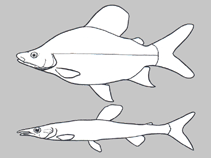
Raggi dorsali molli (totale) : 22 - 26; Raggi anali molli: 13 - 15. Diagnosis: depth of body 2.5-3.5 times in standard length, length of head 3 (in young fishes) to 5 times (in adults) (Ref. 4903). Snout not elongated (Ref. 28714), rounded (Ref. 4903), not or slightly projecting beyond the mouth (Ref. 4903, 28714). Maxilla extending to below the nostrils; upper surface of the head, and the operculum ridged with low, radiating striations (Ref. 4903). Teeth all small and bicuspidate (Ref. 28714), in two series, outer with 24-36 teeth (Ref. 4903). Dorsal fin with 22-26 rays, the first 3-6 unbranched (Ref. 4903). Adipose fin covered with small scales (Ref. 4903, 28714), small, its basal length about 2-4 times its distance from the posterior margin of the dorsal fin (Ref. 28714). Anal fin with 13-15 rays, the first 3-4 unbranched; caudal fin forked, its rounded lobes almost entirely scaled; lateral line with 90-110 scales (Ref. 4903). 18-21 scales between lateral line and dorsal-fin origin (Ref. 4903, 28714). 15-18 scales between insertion of pelvic fin and lateral line (Ref. 4903). Large robust fish as adults (Ref. 28714).
Coloration: purplish-silver above, silver below; young fishes with several vertical dark bars on the flank (Ref. 4903).
In Lake Albert found in the shallow inshore waters, especially in the region of
deltas; also in rivers (Ref. 4903). Macro-herbivore, feeds on submerged water plants (Ref. 4903, 28714), Eichornia roots and periphyton (Ref. 28714), but also molluscs and small Crustacea (Ref. 4903). Oviparous (Ref. 205).
Ciclo vitale e comportamento di accoppiamento
Maturità | Riproduzione | Deposizione | Uova | Fecondità | Larve
Oviparous (Ref. 205). Distinct pairing occurs (Ref. 205). Males lingering near the nesting site deemed as the closest thing to parental care (Ref. 205).
Daget, J. and J.-P. Gosse, 1984. Distichodontidae. p. 184-211. In J. Daget, J.-P. Gosse and D.F.E. Thys van den Audenaerde (eds.) Check-list of the freshwater fishes of Africa (CLOFFA). ORSTOM, Paris and MRAC, Tervuren. Vol. 1. (Ref. 7094)
Stato della Lista Rossa IUCN (Ref. 130435: Version 2025-2 (Global))
Minaccia per l'uomo
Harmless
Usi umani
Strumenti
Rapporti speciali
Scarica XML
Fonti Internet
Stime basate su modelli
Indice di diversità filogenetica (Fonte Biblio.
82804): PD
50 = 0.5000 [Uniqueness, from 0.5 = low to 2.0 = high].
Bayesian length-weight: a=0.00447 (0.00186 - 0.01072), b=3.17 (2.97 - 3.37), in cm total length, based on LWR estimates for this (Sub)family-body shape (Ref.
93245).
Livello trofico (Fonte Biblio.
69278): 2.0 ±0.00 se; based on food items.
Vulnerabilità della pesca (Ref.
59153): Moderate to high vulnerability (53 of 100).
🛈