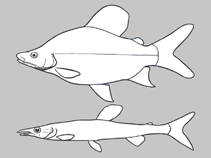
Taxonomic Remarks
See explanation of name change from Distichodus niloticus (Hasselquist, 1762) in Eschmeyer (CofF ver. Oct. 2012: Ref. 92135) according to Fricke (2008: Ref. 83466).
Περιβάλλον: περιβάλλον / κλιματική ζώνη / εύρος βάθους / εύρος διανομής
Οικολογία
; Γλυκού νερού Πελαγικό(ά). Tropical
Africa: Lake Albert (Ref. 4903, 49805), Lakes Turkana and No, Murchison Nile (Ref. 4903), White and Blue Nile, and the Chad basin where it is uncommon (Ref. 7094).
Μέγεθος / Βάρος / Ηλικία
Γεννητική Ωρίμανση: Lm ? range ? - ? cm
Max length : 83.0 cm TL αρσενικό/απροσδιόριστο; (Ref. 7094); μεγ. δημοσιευμένο βάρος: 6.2 kg (Ref. 7094)
Σύντομη περιγραφή
Κλείδες προσδιορισμού | Μορφολογία | Μορφομετρία
Μαλακές ραχιαίες ακτίνες (συνολικά) : 22 - 26; Μαλακές εδρικές ακτίνες: 13 - 15. Diagnosis: depth of body 2.5-3.5 times in standard length, length of head 3 (in young fishes) to 5 times (in adults) (Ref. 4903). Snout not elongated (Ref. 28714), rounded (Ref. 4903), not or slightly projecting beyond the mouth (Ref. 4903, 28714). Maxilla extending to below the nostrils; upper surface of the head, and the operculum ridged with low, radiating striations (Ref. 4903). Teeth all small and bicuspidate (Ref. 28714), in two series, outer with 24-36 teeth (Ref. 4903). Dorsal fin with 22-26 rays, the first 3-6 unbranched (Ref. 4903). Adipose fin covered with small scales (Ref. 4903, 28714), small, its basal length about 2-4 times its distance from the posterior margin of the dorsal fin (Ref. 28714). Anal fin with 13-15 rays, the first 3-4 unbranched; caudal fin forked, its rounded lobes almost entirely scaled; lateral line with 90-110 scales (Ref. 4903). 18-21 scales between lateral line and dorsal-fin origin (Ref. 4903, 28714). 15-18 scales between insertion of pelvic fin and lateral line (Ref. 4903). Large robust fish as adults (Ref. 28714).
Coloration: purplish-silver above, silver below; young fishes with several vertical dark bars on the flank (Ref. 4903).
In Lake Albert found in the shallow inshore waters, especially in the region of
deltas; also in rivers (Ref. 4903). Macro-herbivore, feeds on submerged water plants (Ref. 4903, 28714), Eichornia roots and periphyton (Ref. 28714), but also molluscs and small Crustacea (Ref. 4903). Oviparous (Ref. 205).
Κύκλος ζωής και συμπεριφορά ζευγαρώματος
Γεννητική Ωρίμανση | Αναπαραγωγή | Γεννοβολία | Αβγά | Γονιμότητα | Προνύμφες
Oviparous (Ref. 205). Distinct pairing occurs (Ref. 205). Males lingering near the nesting site deemed as the closest thing to parental care (Ref. 205).
Daget, J. and J.-P. Gosse, 1984. Distichodontidae. p. 184-211. In J. Daget, J.-P. Gosse and D.F.E. Thys van den Audenaerde (eds.) Check-list of the freshwater fishes of Africa (CLOFFA). ORSTOM, Paris and MRAC, Tervuren. Vol. 1. (Ref. 7094)
Κατάσταση Κόκκινου Καταλόγου IUCN (Ref. 130435: Version 2025-2 (Global))
Απειλή για τον άνθρωπο
Harmless
Ανθρώπινες χρήσεις
Εργαλεία
Ειδικές εκθέσεις
Λήψη XML
Διαδικτυακές πηγές
Εκτιμήσεις βάσει μοντέλων
Δείκτης φυλογενετικής ποικιλότητας (Αναφ.
82804): PD
50 = 0.5000 [Uniqueness, from 0.5 = low to 2.0 = high].
Bayesian length-weight: a=0.00447 (0.00186 - 0.01072), b=3.17 (2.97 - 3.37), in cm total length, based on LWR estimates for this (Sub)family-body shape (Ref.
93245).
Τροφικό Επίπεδο (Αναφ.
69278): 2.0 ±0.00 se; based on food items.
Ευπάθεια στην αλιεία (Ref.
59153): Moderate to high vulnerability (53 of 100).
🛈