Mugil incilis, Parassi mullet : fisheries

You can sponsor this page

Mugil incilis Hancock, 1830

Parassi mullet
Waarneming toevoegen in Fish Watcher
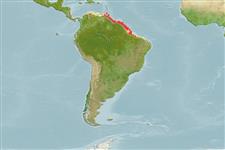
Native range
This map was computer-generated and has not yet been reviewed.
Mugil incilis   AquaMaps   Data sources: GBIF OBIS
Uploaden van uw Foto's en video's
Afbeeldingen | Google afbeelding
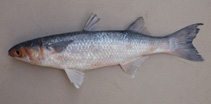
Image of Mugil incilis (Parassi mullet)
Mugil incilis
Afbeelding van Carvalho Filho, A.

Classificatie / Namen Lokale namen | Synoniemen | Catalog of Fishes(Genus, Soort(en)) | ITIS | CoL | WoRMS | Cloffa

> Mugiliformes (Mullets) > Mugilidae (Mullets)
Etymology: Mugil: Latin, mugil, -ilis = grey mullet (Ref. 45335).

Milieu: milieu / Klimaatzone / Diepte / verspreidingsgebied Ecologie

marien; brak water demersaal; diepte 10 - ? m (Ref. 5217). Tropical; 13°N - 9°S

Verspreiding Gebieden | FAO regio's | Ecosystemen | Voorkomen | Verspreidingskaart | Introducties | Faunafri

Western Atlantic: West Indies and the Atlantic coasts of Central and South America to southeastern Brazil.

Lengte bij maturiteit / Grootte / Gewicht / Leeftijd

Maturiteit: Lm ?, range 24 - ? cm
Max length : 40.0 cm TL mannelijk / geslacht onbekend; (Ref. 3791); 35.0 cm TL (female); common length : 25.0 cm TL mannelijk / geslacht onbekend; (Ref. 5217)

Korte beschrijving Determinatiesleutels | Morfologie | Morfometrie


Body shape (shape guide): fusiform / normal.

Biologie     Verklarende woordenlijst (bv. epibenthic)

Mainly found in brackish estuaries but also in marine and hyper-saline waters (Ref. 5217). During reproduction, they gather in small groups at the mouth of coastal rivers and creeks. Reproduction occurs in the early part of the year. Oviparous, eggs are pelagic and non-adhesive (Ref. 205). Eggs which are rich in yolk are spawned by the millions. Upon hatching, juveniles move up to the swamps and coastal rivers over long distances, to seek for food and to protect themselves against predators (Ref. 35237). Marketed fresh or salted (Ref. 5217). The roe is marketed salt-pickled and dried and considered a delicacy (Ref. 5217).

Levenscyclus en paargedrag Maturiteit | Voortplanting | Paaien | Eieren | Fecunditeit | Larven

Spawning seems to take place in small groups in river mouths. Females lay millions of relatively large eggs rich in yolk.

Hoofdreferentie Upload uw referenties | Referenties | Coördinator : Harrison, Ian | Medewerkers

Thomson, J.M., 1978. Mugilidae. In W. Fischer (ed.) FAO species identification sheets for fishery purposes. Western Central Atlantic (Fishing Area 31). Vol. 3. [pag. var.]. FAO, Rome. (Ref. 3791)

Status op de Rode Lijst van het IUCN (Ref. 130435: Version 2025-2 (Global))

  Niet bedreigd (LC) ; Date assessed: 04 February 2009

CITES

Not Evaluated

CMS (Ref. 116361)

Not Evaluated

Gevaar voor de mens

  Harmless


Gebruik door de mens

Visserij: van minder commercieel belang
FAO - visserij: aanvoer; Publication: search | FishSource | Sea Around Us

Meer informatie

Trofische ecologie
Voedsel (prooien)
Dieetsamenstelling
Voedselconsumptie
Voedselrantsoenen
Predatoren
Ecologie
Ecologie
Populatiedynamica
Groeiparameters
Max. leeftijden / maten
Lengte-gewicht rel.
Lengte-lengte rel.
Lengtefrequenties
Massaconversie
Rekrutering
Abundantie
Levenscyclus
Voortplanting
Maturiteit
Rijpheid/kieuwen rel.
Fecunditeit
Paaien
Paaibestanden
Eieren
Ontwikkeling van de eieren
Larven
Larvale populatiedynamiek
Verspreiding
Gebieden
FAO regio's
Ecosystemen
Voorkomen
Introducties
BRUVS - Video's
Anatomie
Kieuwoppervlak
Hersenen
Otoliet
Fysiologie
Lichaamssamenstelling
Voedingsstoffen
Zuurstofverbruik
Type zwemmen
Zwemsnelheid
Visuele pigmenten
Vis geluid
Ziekten en parasieten
Toxiciteit (LC50)
Genetica
genoom
Genetica
Heterozygositeit
Erfelijkheid
Genetische diversiteit
Menselijk gerelateerd
Aquacultuursystemen
Aquacultuurprofielen
Kweeklijnen
Ciguatera gevallen
Postzegels, munten, diversen.
Outreach
Medewerkers
Referenties
Referenties

Tools

Speciale rapporten

Download XML

Internetbronnen

AFORO (otoliths) | Aquatic Commons | BHL | Cloffa | Websites from users | Bekijk FishWatcher | CISTI | Catalog of Fishes: Genus, Soort(en) | DiscoverLife | ECOTOX | FAO - visserij: aanvoer; Publication: search | Faunafri | Fishipedia | Fishtrace | GloBI | Google Books | Google Scholar | Google | IGFA World Record | OneZoom | Open Tree of Life | Otolith Atlas of Taiwan Fishes | PubMed | Reef Life Survey | Socotra Atlas | TreeBase | Tree of Life | Wikipedia: ga naar, zoek | World Records Freshwater Fishing | Zoobank | Zoological Record

Schattingen op basis van modellen

Gewenste temperatuur (Ref. 123201): 26.7 - 28.1, mean 27.4 °C (based on 46 cells).
Fylogenetische diversiteitsindex (Ref. 82804):  PD50 = 0.5000   [Uniqueness, from 0.5 = low to 2.0 = high].
Bayesian length-weight: a=0.00977 (0.00600 - 0.01591), b=2.91 (2.78 - 3.04), in cm total length, based on LWR estimates for this species & Genus-body shape (Ref. 93245).
Trofisch niveau (Ref. 69278):  2.0   ±0.1 se; based on diet studies.
Generation time: 1.6 ( na - na) years. Estimated as median ln(3)/K based on 1 growth studies.
Weerstandsvermogen (Ref. 120179):  Hoog, minimale populatieverdubbelingstijd minder dan 15 maanden (K=0.67-1.0;).
Kwetsbaarheid van de visserij (Ref. 59153):  Low vulnerability (24 of 100). 🛈
Prijsklasse (Ref. 80766):   Medium.
Voedingsstoffen (Ref. 124155):  Calcium = 482 [175, 1,568] mg/100g; Iron = 3.8 [0.7, 17.5] mg/100g; Protein = 19.2 [17.6, 20.7] %; Omega3 = 0.359 [0.158, 0.859] g/100g; Selenium = 150 [48, 491] μg/100g; VitaminA = 7.99 [2.21, 28.34] μg/100g; Zinc = 3.19 [1.47, 7.74] mg/100g (wet weight);