Taxonomic Remarks
Genetic data indicate that Chelon monticola is a complex of species with partially overlapping distributions, At least 4 species have been recognized in separate areas (Durand & Borsa, 2015: Ref. 123262), The name should be applied only in the Caribbean sea (see Fig.3 in McMahan et al., 2013: Ref. 123341).
Meio ambiente: milieu / Zona climática / intervalo de profundidade / faixa de distribuição
Ecologia
marinhas; Água doce; estuarina pelagic-neritic; catádromo (Ref. 126106). Subtropical; 20°C - 31°C (Ref. 36880); 37°N - 0°N, 113°W - 59°W (Ref. 86798)
Western Atlantic: North Carolina to Texas in the USA south to Venezuela, including the West Indies.
Comprimento de primeira maturação / Tamanho / Peso / Idade
Maturidade: Lm 16.6, range 12 - ? cm
Max length : 36.0 cm TL macho/indeterminado; (Ref. 9321)
Espinhos dorsais (total) : 5; Raios dorsais (total) : 8; Espinhos anais: 2; Raios anais : 9.
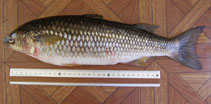
Body shape (shape guide): fusiform / normal.
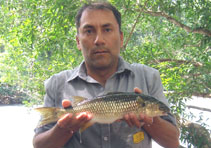
Adults inhabit pools and runs of small to medium rivers (Ref. 86798). They live in freshwater rivers and streams. Young are encountered occasionally in brackish waters. This is the only mullet that ascends far inland and spends all its adult life in freshwater (Ref. 11225). Tend to be few and solitary in upper streams, but form uneven schools in larger streams at lower elevations (Ref. 11225). Oviparous, eggs are pelagic and non-adhesive (Ref. 205). Usually spawn during the rainy season (Ref. 42119). Caught and consumed by local populations in some parts of central America.
Spawning period coincides with the rainy season in some areas where it occurs (Ref. 42119).
Harrison, I.J., 1995. Mugilidae. Lisas. p. 1293-1298. In W. Fischer, F. Krupp, W. Schneider, C. Sommer, K.E. Carpenter and V. Niem (eds.) Guia FAO para Identification de Especies para lo Fines de la Pesca. Pacifico Centro-Oriental. 3 Vols. FAO, Rome. (Ref. 9321)
Status na Lista Vermelha da UICN (Ref. 130435: Version 2025-2 (Global))
Ameaça para os humanos
Harmless
Uso pelos humanos
Pescarias: pesca de subsistência
Ferramentas
Relatórios especiais
Baixar XML
Fontes da internet
Estimativas baseadas em modelos
Temperatura preferida (Ref.
123201): 24.4 - 28, mean 26.8 °C (based on 208 cells).
Índice de diversidade filogenética (Ref.
82804): PD
50 = 1.0000 [Uniqueness, from 0.5 = low to 2.0 = high].
Bayesian length-weight: a=0.01202 (0.00791 - 0.01828), b=3.03 (2.91 - 3.15), in cm total length, based on LWR estimates for this species & (Sub)family-body (Ref.
93245).
Nível Trófico (Ref.
69278): 3.0 ±0.40 se; based on food items.
Resiliência (Ref.
120179): Elevada, tempo mínimo de duplicação da população menor que 15 meses (Fec = 128,827).
Vulnerabilidade da pesca (Ref.
59153): Low to moderate vulnerability (26 of 100).
🛈
Nutrientes (Ref.
124155): Calcium = 115 [44, 255] mg/100g; Iron = 1.36 [0.64, 2.96] mg/100g; Protein = 19.3 [17.7, 21.0] %; Omega3 = 0.568 [0.271, 1.217] g/100g; Selenium = 16.1 [8.1, 34.6] μg/100g; VitaminA = 14.6 [4.4, 52.3] μg/100g; Zinc = 1.18 [0.82, 1.76] mg/100g (wet weight);