Taxonomic Remarks
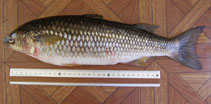
Genetic data indicate that Chelon monticola is a complex of species with partially overlapping distributions, At least 4 species have been recognized in separate areas (Durand & Borsa, 2015: Ref. 123262), The name should be applied only in the Caribbean sea (see Fig.3 in McMahan et al., 2013: Ref. 123341).
Ambiente: milieu / zona climatica / distribuzione batimetrica / gamma di distribuzione
Ecologia
marino; acqua dolce; salmastro pelagic-neritic; catadromo (Ref. 126106). Subtropical; 20°C - 31°C (Ref. 36880); 37°N - 0°N, 113°W - 59°W (Ref. 86798)
Western Atlantic: North Carolina to Texas in the USA south to Venezuela, including the West Indies.
Lunghezza alla prima maturità / Dimensione / Peso / Età
Maturità: Lm 16.6, range 12 - ? cm
Max length : 36.0 cm TL maschio/sesso non determinato; (Ref. 9321)
Spine dorsali (totale) : 5; Raggi dorsali molli (totale) : 8; Spine anali: 2; Raggi anali molli: 9.
Body shape (shape guide): fusiform / normal.
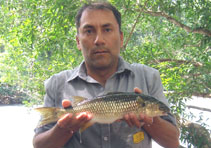
Adults inhabit pools and runs of small to medium rivers (Ref. 86798). They live in freshwater rivers and streams. Young are encountered occasionally in brackish waters. This is the only mullet that ascends far inland and spends all its adult life in freshwater (Ref. 11225). Tend to be few and solitary in upper streams, but form uneven schools in larger streams at lower elevations (Ref. 11225). Oviparous, eggs are pelagic and non-adhesive (Ref. 205). Usually spawn during the rainy season (Ref. 42119). Caught and consumed by local populations in some parts of central America.
Spawning period coincides with the rainy season in some areas where it occurs (Ref. 42119).
Harrison, I.J., 1995. Mugilidae. Lisas. p. 1293-1298. In W. Fischer, F. Krupp, W. Schneider, C. Sommer, K.E. Carpenter and V. Niem (eds.) Guia FAO para Identification de Especies para lo Fines de la Pesca. Pacifico Centro-Oriental. 3 Vols. FAO, Rome. (Ref. 9321)
Stato della Lista Rossa IUCN (Ref. 130435: Version 2025-2 (Global))
Minaccia per l'uomo
Harmless
Usi umani
Pesca: pesca di sussistenza
Strumenti
Rapporti speciali
Scarica XML
Fonti Internet
Stime basate su modelli
Temperatura preferita (Fonte Biblio.
123201): 24.4 - 28, mean 26.8 °C (based on 208 cells).
Indice di diversità filogenetica (Fonte Biblio.
82804): PD
50 = 1.0000 [Uniqueness, from 0.5 = low to 2.0 = high].
Bayesian length-weight: a=0.01202 (0.00791 - 0.01828), b=3.03 (2.91 - 3.15), in cm total length, based on LWR estimates for this species & (Sub)family-body (Ref.
93245).
Livello trofico (Fonte Biblio.
69278): 3.0 ±0.40 se; based on food items.
Resilienza (Fonte Biblio.
120179): Alto, tempo minimo di raddoppiamento della popolazione meno di 15 mesi (Fec = 128,827).
Vulnerabilità della pesca (Ref.
59153): Low to moderate vulnerability (26 of 100).
🛈
Nutrienti (Ref.
124155): Calcium = 115 [44, 255] mg/100g; Iron = 1.36 [0.64, 2.96] mg/100g; Protein = 19.3 [17.7, 21.0] %; Omega3 = 0.568 [0.271, 1.217] g/100g; Selenium = 16.1 [8.1, 34.6] μg/100g; VitaminA = 14.6 [4.4, 52.3] μg/100g; Zinc = 1.18 [0.82, 1.76] mg/100g (wet weight);