>
Lampriformes (Velifers, tube-eyes and ribbonfishes) >
Lampridae (Opahs)
Etymology: Lampris: Greek, lampros = light (Ref. 45335).
Taxonomic Remarks
Some information in this summary page may be referring to other species included in this species complex. Modification ongoing.
Entorno: milieu / zona climática / rango de profundidad / gama de distribución
Ecología
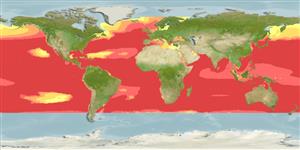
marino batipelágico; oceanodromo (Ref. 51243). Deep-water; 75°N - 60°S, 180°W - 180°E
North Atlantic: including the Irish Sea, the North Sea, and the Mediterranean.
Tamaño / Peso / Edad
Madurez: Lm ? range ? - ? cm
Max length : 101 cm SL macho / no sexado; (Ref. 126789); peso máximo publicado: 270.0 kg (Ref. 5188)
Descripción breve
Claves de identificación | Morfología | Morfometría
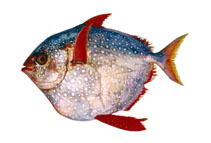
Espinas dorsales (total) : 0; Radios blandos dorsales (total) : 48 - 55; Espinas anales: 0; Radios blandos anales: 33 - 41; Vértebra: 43. Caudal fin broadly lunate; pectorals long and falcate; pelvic fins similar to pectoral fins in shape and a little longer (Ref. 6885). Dark steely blue dorsally shading into green with silver and purple iridescence, belly rosy, body covered with silvery spots in irregular rows, light mottling on caudal and dorsal fins; vermillion on fins and jaws, golden around eyes (Ref. 6885).
Body shape (shape guide): short and / or deep.
Oceanic and apparently solitary (Ref. 6737). Epi- and mesopelagic (Ref. 58302). Feeds on midwater fishes and invertebrates, mainly squids (Ref. 6737). Probably spawns in the spring (Ref. 6885). Occasionally taken as a by-catch of tuna fisheries. Considered a good food fish (Ref. 5242); marketed fresh and frozen; prepared as sashimi (Ref. 9987). Swims by flapping the pectoral fins (Ref. 36731).
Ciclo vital y comportamiento de apareamiento
Madurez | Reproducción | Puesta | Huevos | Fecundidad | Larva
Underkoffler, K.E., M.A. Luers, J.R. Hyde and M.T. Craig, 2018. A taxonomic review of Lampris guttatus (Brünnich 1788) (Lampridiformes; Lampridae) with descriptions of three new species. Zootaxa 4413(3):551-565. (Ref. 126789)
Situación en la Lista Roja de la UICN (Ref. 130435: Version 2025-2 (Global))
Amenaza para el ser humano
Harmless
Usos humanos
Pesquerías: escaso valor comercial; pesca deportiva: si
Herramientas
Informes especiales
Descargar XML
Fuentes de Internet
Estimaciones basadas en modelos
Temperatura preferida (Referencia
123201): 5 - 19.9, mean 12.1 °C (based on 1423 cells).
Índice de diversidad filogenética (Referencia
82804): PD
50 = 0.5312 [Uniqueness, from 0.5 = low to 2.0 = high].
Bayesian length-weight: a=0.01995 (0.00906 - 0.04395), b=3.01 (2.83 - 3.19), in cm total length, based on all LWR estimates for this body shape (Ref.
93245).
Nivel trófico (Referencia
69278): 4.2 ±0.62 se; based on food items.
Generation time: 5.0 ( na - na) years. Estimated as median ln(3)/K based on 1
growth studies.
Resiliencia (Referencia
120179): Bajo, población duplicada en un tiempo mínimo de 4.5-14 años (Assuming tm>4).
Prior r = 0.28, 95% CL = 0.18 - 0.42, Based on 1 data-limited stock assessment.
Vulnerabilidad pesquera (Ref.
59153): Moderate to high vulnerability (55 of 100).
🛈
Vulnerabilidad climática (Ref.
125649): Moderate vulnerability (38 of 100).
🛈
Nutrientes (Ref.
124155): Calcium = 13 [4, 32] mg/100g; Iron = 0.295 [0.127, 0.889] mg/100g; Protein = 21.3 [16.9, 24.1] %; Omega3 = 0.148 [0.055, 0.397] g/100g; Selenium = 21.5 [7.0, 69.8] μg/100g; VitaminA = 9.27 [1.00, 83.81] μg/100g; Zinc = 0.245 [0.123, 0.529] mg/100g (wet weight); based on
nutrient studies.