>
Lampriformes (Velifers, tube-eyes and ribbonfishes) >
Lampridae (Opahs)
Etymology: Lampris: Greek, lampros = light (Ref. 45335).
Taxonomic Remarks
Some information in this summary page may be referring to other species included in this species complex. Modification ongoing.
Umwelt: Milieu / Klimazone / Tiefenbereich / Verbreitungsgebiet
Ökologie
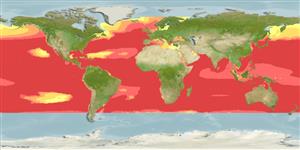
seewasser bathypelagisch; ozeanodrom (Ref. 51243). Deep-water; 75°N - 60°S, 180°W - 180°E
North Atlantic: including the Irish Sea, the North Sea, and the Mediterranean.
Größe / Gewicht / Alter
Geschlechtsreife: Lm ? range ? - ? cm
Max length : 101 cm SL Männchen/unbestimmt; (Ref. 126789); max. veröff. Gewicht: 270.0 kg (Ref. 5188)
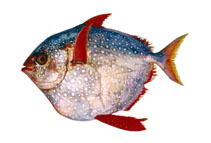
Rückenflossenstacheln (insgesamt) : 0; Rückenflossenweichstrahlen (insgesamt) : 48 - 55; Afterflossenstacheln: 0; Afterflossenweichstrahlen: 33 - 41; Wirbelzahl: 43. Caudal fin broadly lunate; pectorals long and falcate; pelvic fins similar to pectoral fins in shape and a little longer (Ref. 6885). Dark steely blue dorsally shading into green with silver and purple iridescence, belly rosy, body covered with silvery spots in irregular rows, light mottling on caudal and dorsal fins; vermillion on fins and jaws, golden around eyes (Ref. 6885).
Body shape (shape guide): short and / or deep.
Oceanic and apparently solitary (Ref. 6737). Epi- and mesopelagic (Ref. 58302). Feeds on midwater fishes and invertebrates, mainly squids (Ref. 6737). Probably spawns in the spring (Ref. 6885). Occasionally taken as a by-catch of tuna fisheries. Considered a good food fish (Ref. 5242); marketed fresh and frozen; prepared as sashimi (Ref. 9987). Swims by flapping the pectoral fins (Ref. 36731).
Lebenszyklus und Paarungsverhalten
Geschlechtsreife | Fortpflanzung | Ablaichen | Eier | Fruchtbarkeit | Larven
Underkoffler, K.E., M.A. Luers, J.R. Hyde and M.T. Craig, 2018. A taxonomic review of Lampris guttatus (Brünnich 1788) (Lampridiformes; Lampridae) with descriptions of three new species. Zootaxa 4413(3):551-565. (Ref. 126789)
IUCN Rote Liste Status (Ref. 130435: Version 2025-2 (Global))
Bedrohung für Menschen
Harmless
Nutzung durch Menschen
Fischereien: weniger kommerziell; Sportfisch: ja
Tools
Zusatzinformationen
Download XML
Internet Quellen
Schätzungen auf der Grundlage von Modellen
Bevorzugte Temperatur (Ref.
123201): 5 - 19.9, mean 12.1 °C (based on 1423 cells).
Phylogenetischer Diversitätsindex (Ref.
82804): PD
50 = 0.5312 [Uniqueness, from 0.5 = low to 2.0 = high].
Bayesian length-weight: a=0.01995 (0.00906 - 0.04395), b=3.01 (2.83 - 3.19), in cm total length, based on all LWR estimates for this body shape (Ref.
93245).
Trophische Ebene (Ref.
69278): 4.2 ±0.62 se; based on food items.
Generation time: 5.0 ( na - na) years. Estimated as median ln(3)/K based on 1
growth studies.
Widerstandsfähigkeit (Ref.
120179): niedrig, Verdopplung der Population dauert 4,5 - 14 Jahre. (Assuming tm>4).
Prior r = 0.28, 95% CL = 0.18 - 0.42, Based on 1 data-limited stock assessment.
Anfälligkeit der Fischerei (Ref.
59153): Moderate to high vulnerability (55 of 100).
🛈
Klimaanfälligkeit (Ref.
125649): Moderate vulnerability (38 of 100).
🛈
Nährstoffe (Ref.
124155): Calcium = 13 [4, 32] mg/100g; Iron = 0.295 [0.127, 0.889] mg/100g; Protein = 21.3 [16.9, 24.1] %; Omega3 = 0.148 [0.055, 0.397] g/100g; Selenium = 21.5 [7.0, 69.8] μg/100g; VitaminA = 9.27 [1.00, 83.81] μg/100g; Zinc = 0.245 [0.123, 0.529] mg/100g (wet weight); based on
nutrient studies.