>
Holocentriformes (Squirrelfishes, soldierfishes) >
Holocentridae (Squirrelfishes, soldierfishes) > Holocentrinae
Etymology: Holocentrus: Greek, holos = full + Greek, kentron = sting (Ref. 45335).
Environnement : milieu / zone climatique / profondeur / gamme de distribution
Écologie
marin récifal; profondeur 0 - 180 m (Ref. 26938), usually 8 - 30 m (Ref. 3156). Subtropical; 37°N - 25°S, 97°W - 13°E
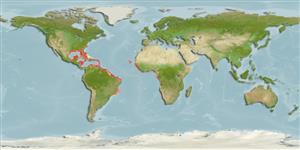
Western Central Atlantic: North Carolina, USA and Bermuda to Brazil, including the Gulf of Mexico and throughout the West Indies and Caribbean shores (Ref. 3724). Eastern Central Atlantic: Sao Tome Island and Gabon to Angola (Ref. 51178) and St. Paul's Rocks, St. Helena and Ascension Island (Ref. 6537).
Longueur à la première maturité / Taille / Poids / Âge
Maturité: Lm 14.6 range ? - 16.64 cm
Max length : 61.0 cm TL mâle / non sexé; (Ref. 3634); common length : 25.0 cm TL mâle / non sexé; (Ref. 5217)
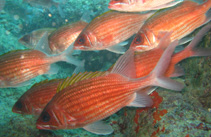
Épines dorsales (Total) : 11; Rayons mous dorsaux (Total) : 15 - 16; Épines anales: 4; Rayons mous anaux: 9 - 10. Tip of membranes of spinous dorsal fin reddish or translucent, not whitish; posterior margin of upper jaw reaching posterior margin of pupil (Ref. 13608). Spiny and soft parts of dorsal fin nearly separate, but connected by low membrane (Ref. 26938). Dull red or pinkish, sometimes blotched (Ref. 7251).
Body shape (shape guide): fusiform / normal.
Occurs in shallow coral reefs, as well as deeper offshore waters (Ref. 3724). A nocturnal species, hiding in deep crevices or under coral ledges during the day; at night it usually moves over sand and grass beds, taking mainly crabs and other small crustaceans (Ref. 3634). Capable of producing sounds (Ref. 6537). Spawning documented as far north as North Carolina in May (Ref. 27549). Marketed fresh (Ref. 3724).
Cycle de vie et comportement reproducteur
Maturité | Reproduction | Frai | Œufs | Fécondité | Larves
Robins, C.R. and G.C. Ray, 1986. A field guide to Atlantic coast fishes of North America. Houghton Mifflin Company, Boston, U.S.A. 354 p. (Ref. 7251)
Statut dans la liste rouge de l'IUCN (Ref. 130435: Version 2025-2 (Global))
Menace pour l'homme
Reports of ciguatera poisoning (Ref. 30303)
Utilisations par l'homme
Pêcheries: intérêt commercial mineur; Aquarium: Aquariums publics
Outils
Articles particuliers
Télécharger en XML
Sources Internet
Estimations basées sur des modèles
Température préférée (Réf.
123201): 23.4 - 28, mean 26.1 °C (based on 472 cells).
Indice de diversité phylogénétique (Réf.
82804): PD
50 = 0.7500 [Uniqueness, from 0.5 = low to 2.0 = high].
Bayesian length-weight: a=0.01585 (0.01279 - 0.01964), b=2.95 (2.89 - 3.01), in cm total length, based on LWR estimates for this species (Ref.
93245).
Niveau trophique (Réf.
69278): 3.1 ±0.3 se; based on diet studies.
Résilience (Réf.
120179): Milieu, temps minimum de doublement de population : 1,4 à 4,4 années (Preliminary K or Fecundity.).
Vulnérabilité de la pêche (Ref.
59153): Moderate vulnerability (44 of 100).
🛈
Nutriments (Ref.
124155): Calcium = 21.1 [9.3, 54.2] mg/100g; Iron = 0.544 [0.219, 1.093] mg/100g; Protein = 19.2 [18.0, 20.3] %; Omega3 = 0.231 [0.095, 0.539] g/100g; Selenium = 23.2 [12.7, 44.7] μg/100g; VitaminA = 30.6 [10.8, 90.6] μg/100g; Zinc = 0.719 [0.446, 1.132] mg/100g (wet weight);