>
Holocentriformes (Squirrelfishes, soldierfishes) >
Holocentridae (Squirrelfishes, soldierfishes) > Holocentrinae
Etymology: Holocentrus: Greek, holos = full + Greek, kentron = sting (Ref. 45335).
Milieu: milieu / Klimaatzone / Diepte / verspreidingsgebied
Ecologie
marien rifbewoner; diepte 0 - 180 m (Ref. 26938), usually 8 - 30 m (Ref. 3156). Subtropical; 37°N - 25°S, 97°W - 13°E
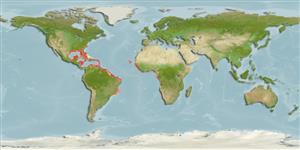
Western Central Atlantic: North Carolina, USA and Bermuda to Brazil, including the Gulf of Mexico and throughout the West Indies and Caribbean shores (Ref. 3724). Eastern Central Atlantic: Sao Tome Island and Gabon to Angola (Ref. 51178) and St. Paul's Rocks, St. Helena and Ascension Island (Ref. 6537).
Lengte bij maturiteit / Grootte / Gewicht / Leeftijd
Maturiteit: Lm 14.6 range ? - 16.64 cm
Max length : 61.0 cm TL mannelijk / geslacht onbekend; (Ref. 3634); common length : 25.0 cm TL mannelijk / geslacht onbekend; (Ref. 5217)
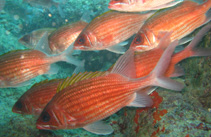
Dorsale stekels (totaal) : 11; Dorsale zachte stralen (totaal) : 15 - 16; Anale stekels: 4; Anale zachte stralen: 9 - 10. Tip of membranes of spinous dorsal fin reddish or translucent, not whitish; posterior margin of upper jaw reaching posterior margin of pupil (Ref. 13608). Spiny and soft parts of dorsal fin nearly separate, but connected by low membrane (Ref. 26938). Dull red or pinkish, sometimes blotched (Ref. 7251).
Body shape (shape guide): fusiform / normal.
Occurs in shallow coral reefs, as well as deeper offshore waters (Ref. 3724). A nocturnal species, hiding in deep crevices or under coral ledges during the day; at night it usually moves over sand and grass beds, taking mainly crabs and other small crustaceans (Ref. 3634). Capable of producing sounds (Ref. 6537). Spawning documented as far north as North Carolina in May (Ref. 27549). Marketed fresh (Ref. 3724).
Levenscyclus en paargedrag
Maturiteit | Voortplanting | Paaien | Eieren | Fecunditeit | Larven
Robins, C.R. and G.C. Ray, 1986. A field guide to Atlantic coast fishes of North America. Houghton Mifflin Company, Boston, U.S.A. 354 p. (Ref. 7251)
Status op de Rode Lijst van het IUCN (Ref. 130435: Version 2025-2 (Global))
Gevaar voor de mens
Reports of ciguatera poisoning (Ref. 30303)
Gebruik door de mens
Visserij: van minder commercieel belang; Aquarium: Publieke aquaria
Tools
Speciale rapporten
Download XML
Internetbronnen
Schattingen op basis van modellen
Gewenste temperatuur (Ref.
123201): 23.4 - 28, mean 26.1 °C (based on 472 cells).
Fylogenetische diversiteitsindex (Ref.
82804): PD
50 = 0.7500 [Uniqueness, from 0.5 = low to 2.0 = high].
Bayesian length-weight: a=0.01585 (0.01279 - 0.01964), b=2.95 (2.89 - 3.01), in cm total length, based on LWR estimates for this species (Ref.
93245).
Trofisch niveau (Ref.
69278): 3.1 ±0.3 se; based on diet studies.
Weerstandsvermogen (Ref.
120179): Gemiddeld, minimale populatieverdubbelingstijd 1,4-4,4 jaar (Preliminary K or Fecundity.).
Kwetsbaarheid van de visserij (Ref.
59153): Moderate vulnerability (44 of 100).
🛈
Voedingsstoffen (Ref.
124155): Calcium = 21.1 [9.3, 54.2] mg/100g; Iron = 0.544 [0.219, 1.093] mg/100g; Protein = 19.2 [18.0, 20.3] %; Omega3 = 0.231 [0.095, 0.539] g/100g; Selenium = 23.2 [12.7, 44.7] μg/100g; VitaminA = 30.6 [10.8, 90.6] μg/100g; Zinc = 0.719 [0.446, 1.132] mg/100g (wet weight);