Elasmobranchi (squali e razze) (sharks and rays) >
Rajiformes (Skates and rays) >
Gurgesiellidae (Pygmy skates)
Etymology: Cruriraja: Latin, crur, cruris = pertaining to a leg + Latin, raja = a ray (Raja sp) (Ref. 45335).
Ambiente: milieu / zona climatica / distribuzione batimetrica / gamma di distribuzione
Ecologia
marino batidemersale; distribuzione batimetrica 150 - 620 m (Ref. 11284). Deep-water; 28°S - 40°S
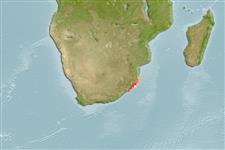
Western Indian Ocean: KwaZulu-Natal, South Africa to Mozambique. Previous records from Namibia to the Eastern Cape Coast of South Africa refer to Cruriraja hulleyi.
Dimensione / Peso / Età
Maturità: Lm ? range ? - ? cm
Max length : 55.0 cm TL maschio/sesso non determinato; (Ref. 5578)
Breve descrizione
Chiavi di identificazione | Morfologia | Morfometria
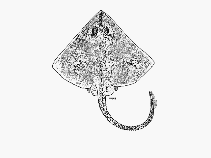
A rough legskate with a pointed snout covered by large conspicuous white thorns that are also found around the eyes, on the shoulders, and in several rows from the nape to the 1st dorsal fin (Ref. 5578). Legskates have pelvic fins separated into a mobile leg-like front lobe, and a rear lobe that may be fused to the tail base (Ref. 5578). Sandy brown above usually with scattered dark brown and whitish spots (very conspicuous in young and becoming obscure in adults; white below (Ref. 5578). Tail with conspicuous dark brown bandings in juveniles (Ref. 5578).
Body shape (shape guide): other.
Found on the uppermost slope (Ref. 5578). Feed on small crustaceans, dragonets, squid, polychaete worms and flatworms (Ref. 5578). Oviparous. Distinct pairing with embrace. Young may tend to follow large objects, such as their mother (Ref. 205). Eggs are oblong capsules with stiff pointed horns at the corners deposited in sandy or muddy flats (Ref. 205). Egg capsules are 4.5 cm long and 2.4 cm wide (Ref. 41249). Caught by hake bottom trawlers (Ref. 5578).
Ciclo vitale e comportamento di accoppiamento
Maturità | Riproduzione | Deposizione | Uova | Fecondità | Larve
Oviparous, paired eggs are laid. Embryos feed solely on yolk (Ref. 50449). Distinct pairing with embrace. Young may tend to follow large objects, such as their mother (Ref. 205).
McEachran, J.D. and K.A. Dunn, 1998. Phylogenetic analysis of skates, a morphologically conservative clade of elasmobranchs (Chondrichthyes: Rajidae). Copeia 1998(2):271-290. (Ref. 27314)
Stato della Lista Rossa IUCN (Ref. 130435: Version 2025-2 (Global))
Minaccia per l'uomo
Harmless
Usi umani
Pesca: bycatch
Strumenti
Rapporti speciali
Scarica XML
Fonti Internet
Stime basate su modelli
Temperatura preferita (Fonte Biblio.
123201): 11.7 - 17.9, mean 15.8 °C (based on 5 cells).
Indice di diversità filogenetica (Fonte Biblio.
82804): PD
50 = 0.5039 [Uniqueness, from 0.5 = low to 2.0 = high].
Bayesian length-weight: a=0.00661 (0.00227 - 0.01925), b=2.95 (2.71 - 3.19), in cm total length, based on LWR estimates for this (Sub)family-body shape (Ref.
93245).
Livello trofico (Fonte Biblio.
69278): 3.6 ±0.53 se; based on food items.
Resilienza (Fonte Biblio.
120179): Basso, tempo minimo di raddoppiamento della popolazione 4.5 - 14 anni (Fec assumed to be <100).
Vulnerabilità della pesca (Ref.
59153): Moderate vulnerability (42 of 100).
🛈