Ελασμοβράγχιοι (καρχαρίες και σαλάχια) (sharks and rays) >
Rajiformes (Skates and rays) >
Gurgesiellidae (Pygmy skates)
Etymology: Cruriraja: Latin, crur, cruris = pertaining to a leg + Latin, raja = a ray (Raja sp) (Ref. 45335).
Περιβάλλον: περιβάλλον / κλιματική ζώνη / εύρος βάθους / εύρος διανομής
Οικολογία
Θαλασσινό(ά) βαθύβιο(ς); εύρος βάθους 150 - 620 m (Ref. 11284). Deep-water; 28°S - 40°S
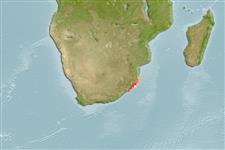
Western Indian Ocean: KwaZulu-Natal, South Africa to Mozambique. Previous records from Namibia to the Eastern Cape Coast of South Africa refer to Cruriraja hulleyi.
Μέγεθος / Βάρος / Ηλικία
Γεννητική Ωρίμανση: Lm ? range ? - ? cm
Max length : 55.0 cm TL αρσενικό/απροσδιόριστο; (Ref. 5578)
Σύντομη περιγραφή
Κλείδες προσδιορισμού | Μορφολογία | Μορφομετρία
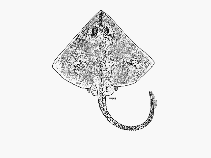
A rough legskate with a pointed snout covered by large conspicuous white thorns that are also found around the eyes, on the shoulders, and in several rows from the nape to the 1st dorsal fin (Ref. 5578). Legskates have pelvic fins separated into a mobile leg-like front lobe, and a rear lobe that may be fused to the tail base (Ref. 5578). Sandy brown above usually with scattered dark brown and whitish spots (very conspicuous in young and becoming obscure in adults; white below (Ref. 5578). Tail with conspicuous dark brown bandings in juveniles (Ref. 5578).
Body shape (shape guide): other.
Found on the uppermost slope (Ref. 5578). Feed on small crustaceans, dragonets, squid, polychaete worms and flatworms (Ref. 5578). Oviparous. Distinct pairing with embrace. Young may tend to follow large objects, such as their mother (Ref. 205). Eggs are oblong capsules with stiff pointed horns at the corners deposited in sandy or muddy flats (Ref. 205). Egg capsules are 4.5 cm long and 2.4 cm wide (Ref. 41249). Caught by hake bottom trawlers (Ref. 5578).
Κύκλος ζωής και συμπεριφορά ζευγαρώματος
Γεννητική Ωρίμανση | Αναπαραγωγή | Γεννοβολία | Αβγά | Γονιμότητα | Προνύμφες
Oviparous, paired eggs are laid. Embryos feed solely on yolk (Ref. 50449). Distinct pairing with embrace. Young may tend to follow large objects, such as their mother (Ref. 205).
McEachran, J.D. and K.A. Dunn, 1998. Phylogenetic analysis of skates, a morphologically conservative clade of elasmobranchs (Chondrichthyes: Rajidae). Copeia 1998(2):271-290. (Ref. 27314)
Κατάσταση Κόκκινου Καταλόγου IUCN (Ref. 130435: Version 2025-2 (Global))
Απειλή για τον άνθρωπο
Harmless
Ανθρώπινες χρήσεις
αλιεία: bycatch
Εργαλεία
Ειδικές εκθέσεις
Λήψη XML
Διαδικτυακές πηγές
Εκτιμήσεις βάσει μοντέλων
Προτιμώμενη θερμοκρασία (Αναφ.
123201): 11.7 - 17.9, mean 15.8 °C (based on 5 cells).
Δείκτης φυλογενετικής ποικιλότητας (Αναφ.
82804): PD
50 = 0.5039 [Uniqueness, from 0.5 = low to 2.0 = high].
Bayesian length-weight: a=0.00661 (0.00227 - 0.01925), b=2.95 (2.71 - 3.19), in cm total length, based on LWR estimates for this (Sub)family-body shape (Ref.
93245).
Τροφικό Επίπεδο (Αναφ.
69278): 3.6 ±0.53 se; based on food items.
Ελαστικότητα (Αναφ.
120179): Χαμηλό, ελάχιστος χρόνος για διπλασιασμό πληθυσμού 4,5 - 14 έτη (Fec assumed to be <100).
Ευπάθεια στην αλιεία (Ref.
59153): Moderate vulnerability (42 of 100).
🛈