Elasmobranchi (squali e razze) (sharks and rays) >
Myliobatiformes (Stingrays) >
Myliobatidae (Eagle and manta rays)
Etymology: Aetomylaeus: Greek, aetos = eagle + Greek, mylio = mill, grinder (Ref. 45335).
Eponymy: Johan Nieuhoff (1618–1672) was a Dutch traveller who wrote about his journeys to India, China and Brazil. [...] (Ref. 128868), visit book page.
More on authors: Bloch & Schneider.
Ambiente: milieu / zona climatica / distribuzione batimetrica / gamma di distribuzione
Ecologia
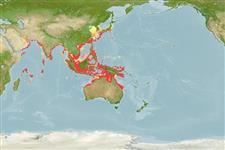
marino; salmastro demersale; amfidromo (Ref. 51243); distribuzione batimetrica 1 - 100 m (Ref. 6871). Tropical; 41°N - 24°S, 51°E - 154°E
Indo-West Pacific: Persian Gulf to the Philippines, north to Korea and southern Japan, south to northern Australia. Possibly in the Red Sea and eastern and southern Africa.
e Indo-West Pacific from the Persian/Arabian Gulf westwards to Indonesia, and north to Taiwan, China and southern Japan.
Lunghezza alla prima maturità / Dimensione / Peso / Età
Maturità: Lm 40.5, range 39 - 42 cm
Max length : 65.0 cm WD maschio/sesso non determinato; (Ref. 47613)
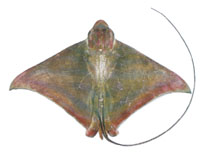
This small species of Aetomylaeus (reaching to about 72.0 cm DW) is distinguished by the following set of characters: dorsal surface is greyish brown with a series of usually 8 (sometimes 7) transverse pale bluish bands (which are sometimes faint), no dark spots or blotches; ventral surface is whitish, pectoral fins is dusky distally; tail is rather long (1.4-1.8 times DW); without stinging spine; short and narrow head; fleshy rostral lobe, relatively broad, short, with a rounded apex; teeth usually in 7 rows in each jaw, with a broad median row flanked by 3 smaller rows on each side; dorsal-fin origin level with pelvic-fin insertions; radials of pectoral-fin 84-88 (excluding concealed propterygial radials anterior of eyes); total vertebral centra (including synarcual) 83-93; males have 16-19 pelvic radials (excluding clasper); females have 20 or 21 pelvic radials (Ref. 103981).
Body shape (shape guide): other; Cross section: flattened.
Maximum depth reported taken from Ref. 9773.
Ciclo vitale e comportamento di accoppiamento
Maturità | Riproduzione | Deposizione | Uova | Fecondità | Larve
Exhibit ovoviparity (aplacental viviparity), with embryos feeding initially on yolk, then receiving additional nourishment from the mother by indirect absorption of uterine fluid enriched with mucus, fat or protein through specialised structures (Ref. 50449). Gives birth to ~4 pups; born at ~17 cm WD (Ref.58048).
Last, P.R. and J.D. Stevens, 1994. Sharks and rays of Australia. CSIRO, Australia. 513 p. (Ref. 6871)
Stato della Lista Rossa IUCN (Ref. 130435: Version 2025-2 (Global))
Minaccia per l'uomo
Harmless
Usi umani
Pesca: scarso interesse commerciale
Strumenti
Rapporti speciali
Scarica XML
Fonti Internet
Stime basate su modelli
Temperatura preferita (Fonte Biblio.
123201): 23.8 - 28.3, mean 27.3 °C (based on 618 cells).
Indice di diversità filogenetica (Fonte Biblio.
82804): PD
50 = 0.5039 [Uniqueness, from 0.5 = low to 2.0 = high].
Bayesian length-weight: a=0.00389 (0.00124 - 0.01219), b=3.08 (2.83 - 3.33), in cm total length, based on LWR estimates for this (Sub)family-body shape (Ref.
93245).
Livello trofico (Fonte Biblio.
69278): 3.9 ±0.48 se; based on food items.
Resilienza (Fonte Biblio.
120179): Molto basso, tempo minimo di raddoppiamento della popolazione più di 14 anni (Fec=4).
Vulnerabilità della pesca (Ref.
59153): Very high vulnerability (83 of 100).
🛈
Nutrienti (Ref.
124155): Calcium = 46.2 [10.7, 204.4] mg/100g; Iron = 0.822 [0.206, 2.137] mg/100g; Protein = 21.5 [16.4, 26.6] %; Omega3 = 0.14 [0.04, 0.52] g/100g; Selenium = 36.8 [9.5, 98.7] μg/100g; VitaminA = 16.9 [7.5, 36.5] μg/100g; Zinc = 1.07 [0.53, 1.96] mg/100g (wet weight);