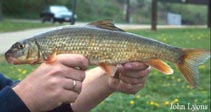
>
Cypriniformes (Carps) >
Catostomidae (Suckers) > Catostominae
Etymology: Moxostoma: Greek, myxo = to suckle + Greek, stoma = mouth (Ref. 45335); duquesnei: Named after Fort Duquesne, upper Ohio River drainage, Pittsburgh, Pennsylvania; type locality (Ref. 10294).
Eponymy: This is not a true eponym, but is named after Fort Duquesne (now Pittsburgh, Pennsylvania, USA) so actually a toponym. The fort was named after Marquis Duquesne, the governor-general of New France (i.e. the area of North America colonised by the French). (Ref. 128868), visit book page.
More on author: Lesueur.
Taxonomic Remarks
The original specific epithet is duquesnii but the unjustified emendation duquesnei is in current prevailing usage (see ECoF for nomenclatural details).
Ambiente: milieu / zona climática / intervalo de profundidade / gama de distribuição
Ecologia
; Água doce demersal; potamódromo (Ref. 126106). Temperate; 43°N - 32°N
North America: lower Great Lakes and Mississippi River basin from Ontario in Canada and from New York to southeastern Minnesota in USA and south to northern Alabama and eastern Oklahoma, USA; upper and middle Mobile Bay drainage in Georgia, Alabama and southeastern Tennessee in USA.
Tamanho / Peso / Idade
Maturidade: Lm ? range ? - ? cm
Max length : 51.0 cm TL macho/indeterminado; (Ref. 5723); common length : 28.5 cm TL macho/indeterminado; (Ref. 12193); peso máx. Publicado: 1.0 kg (Ref. 40637); Idade máx. registada: 10 anos (Ref. 12193)
Adults inhabit sand-bottomed to rock-bottomed pools and runs of creeks and small to medium rivers. Also found in impoundments (Ref. 5723, 10294). Adults feed on small benthic invertebrates, especially microcrustacea and midge larvae (Ref. 10294).
Ciclo de vida e comportamento de acasalamento
Maturidade | Reprodução | Desova | Ovos | Fecundidade | Larvas
Page, L.M. and B.M. Burr, 1991. A field guide to freshwater fishes of North America north of Mexico. Houghton Mifflin Company, Boston. 432 p. (Ref. 5723)
Categoria na Lista Vermelha da IUCN (Ref. 130435: Version 2025-2 (Global))
Ameaça para o homem
Harmless
Utilização humana
Peixe desportivo: sim
Ferramentas
Relatórios especiais
Descarregue XML
Fontes da internet
Estimativas baseadas em modelos
Índice de diversidade filogenética (Ref.
82804): PD
50 = 0.5000 [Uniqueness, from 0.5 = low to 2.0 = high].
Bayesian length-weight: a=0.01023 (0.00754 - 0.01388), b=3.01 (2.95 - 3.07), in cm total length, based on LWR estimates for this species (Ref.
93245).
Nível Trófico (Ref.
69278): 3.0 ±0.41 se; based on food items.
Generation time: 2.8 ( na - na) years. Estimated as median ln(3)/K based on 1
growth studies.
Resiliência (Ref.
120179): Médio, tempo mínimo de duplicação da população 1,4 - 4,4 anos (tmax=10).
Vulnerabilidade da pesca (Ref.
59153): Low to moderate vulnerability (32 of 100).
🛈