>
Cypriniformes (Carps) >
Xenocyprididae (East Asian minnows)
Etymology: Ctenopharyngodon: Greek, kteis, ktenos = comb + Greek, pharyngx = pharynx + greek, odous = teeth (Ref. 45335); idella: From the words cteno, meaning comb; pharyngodon, pharyngeal teeth (referring to the corrugate or comb-like cutting surfaces of the pharyngeal teeth); and idella (derived from ideo), meaning distinctive (Ref. 10294).
More on author: Valenciennes.
Περιβάλλον: περιβάλλον / κλιματική ζώνη / εύρος βάθους / εύρος διανομής
Οικολογία
; Γλυκού νερού; Υφάλμυρο βενθοπελαγικό; ποταμόδρομος (Ref. 126106); εύρος βάθους 0 - 30 m (Ref. 6898). Subtropical; 0°C - 35°C (Ref. 52059); 50°N - 23°N, 100°E - 142°E (Ref. 48)
Asia: Eastern China and Russia (Ref. 48) in eastern Siberia, Amur River system (Ref. 1441). Widely transported around the world (Ref. 7248). Persists only in Europe by stocking (Ref. 59043). Introductions often brought with it the parasitic tapeworm Bothriocephalus opsarichthydis (synonym of B. acheilognathi) (Ref. 12217). Several countries report adverse ecological impact after introduction.
Μήκος κατά την πρώτη ωρίμανση / Μέγεθος / Βάρος / Ηλικία
Γεννητική Ωρίμανση: Lm 68.2, range 58 - 79.2 cm
Max length : 150 cm TL αρσενικό/απροσδιόριστο; (Ref. 30578); common length : 10.7 cm SL αρσενικό/απροσδιόριστο; (Ref. 35840); μεγ. δημοσιευμένο βάρος: 45.0 kg (Ref. 52193); μεγ. αναφερόμενη ηλικία: 21 έτη (Ref. 48)
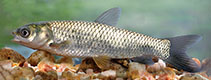
Ραχιαίες άκανθες (συνολικά) : 0; Μαλακές ραχιαίες ακτίνες (συνολικά) : 10 - 11; Εδρικές άκανθες: 0; Μαλακές εδρικές ακτίνες: 10 - 14. Diagnosis: No barbels; snout very short, its length less than or equal to eye diameter; postorbital length more than half head length (Ref. 4967). 18 soft rays for caudal fin (Ref. 40476). Diagnosed from rather similar species Mylopharyngodon piceus by having the following characters: body olive to brassy green above, silvery white to yellow below; body cylindrical; pharyngeal teeth laterally compressed, serrated, with a groove along grinding surface, usually in two rows, 2,5-4,2 (Ref. 59043).
Body shape (shape guide): fusiform / normal.
Adults occur in lakes, ponds, pools and backwaters of large rivers (Ref. 5723), preferring large, slow-flowing or standing water bodies with vegetation (Ref. 52193). They are tolerant of a wide range of temperatures from 0° to 38°C, and salinities to as much as 10 ppt and oxygen levels down to 0.5 ppm (Ref. 52193). They feed on higher aquatic plants and submerged grasses; takes also detritus, insects and other invertebrates. One of the world's most important aquaculture species and also used for weed control in rivers, fish ponds and reservoirs (Ref. 9987). Spawning takes place on riverbeds with very strong current (Ref. 30578). Utilized also fresh and eaten steamed, pan-fried, broiled and baked (Ref. 9987). Considered as a pest in most countries because of the damages made to submerged vegetation (Ref. 43281).
Spawns in gravel bottomed areas of rivers (Ref. 48). Eggs are pelagic and hatch while drifting downstream in 2-3 days (Ref. 59043).
Shireman, J.V. and C.R. Smith, 1983. Synopsis of biological data on the grass carp, Ctenopharyngodon idella (Cuvier and Valenciennes, 1884). FAO Fish. Synop. No.135, 86 p. (Ref. 48)
Κατάσταση Κόκκινου Καταλόγου IUCN (Ref. 130435: Version 2025-2 (Global))
Απειλή για τον άνθρωπο
Potential pest
Ανθρώπινες χρήσεις
αλιεία: περιορισμένης εμπορικότητας; Υδατοκαλλιέργειες: Εμπορικό(ά); αλιεία αναψυχής: ναί
Εργαλεία
Ειδικές εκθέσεις
Λήψη XML
Διαδικτυακές πηγές
Εκτιμήσεις βάσει μοντέλων
Δείκτης φυλογενετικής ποικιλότητας (Αναφ.
82804): PD
50 = 1.0000 [Uniqueness, from 0.5 = low to 2.0 = high].
Bayesian length-weight: a=0.00912 (0.00790 - 0.01053), b=3.09 (3.05 - 3.13), in cm total length, based on LWR estimates for this species (Ref.
93245).
Τροφικό Επίπεδο (Αναφ.
69278): 2.0 ±0.00 se; based on food items.
Ελαστικότητα (Αναφ.
120179): Χαμηλό, ελάχιστος χρόνος για διπλασιασμό πληθυσμού 4,5 - 14 έτη (K=0.13-0.19; tm=2-10; tmax=21; Fec=50,000).
Ευπάθεια στην αλιεία (Ref.
59153): High to very high vulnerability (69 of 100).
🛈
Θρεπτικά συστατικά (Ref.
124155): Calcium = 23.6 [11.8, 60.4] mg/100g; Iron = 0.812 [0.355, 1.761] mg/100g; Protein = 17.3 [15.7, 19.0] %; Omega3 = 0.296 [0.167, 0.545] g/100g; Selenium = 34.8 [17.8, 71.3] μg/100g; VitaminA = 15.6 [3.4, 60.0] μg/100g; Zinc = 0.493 [0.300, 1.558] mg/100g (wet weight); based on
nutrient studies.