>
Gobiiformes (Gobies) >
Gobiidae (Gobies) > Sicydiinae
Etymology: Sicyopterus: Greek, sika, sikya = cucumber + Greek, pteron = wing, fin (Ref. 45335).
More on author: Pallas.
Ambiente: milieu / zona climatica / distribuzione batimetrica / gamma di distribuzione
Ecologia
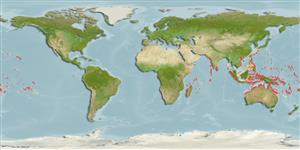
marino; acqua dolce; salmastro demersale; amfidromo (Ref. 48660); distribuzione batimetrica 0 - 5 m (Ref. 86942). Tropical; 42°N - 26°S, 42°E - 128°W
Indo-Pacific: Comoros Islands (East Africa) to Australs Island (French Polynesia) (Ref. 77107). In the Indian Ocean, from Comoros to Mascarene Is. and in the Pacific Ocean, from Japan to French Polynesia, New-Caledonia and Vanuatu (Ref. 87781).
Lunghezza alla prima maturità / Dimensione / Peso / Età
Maturità: Lm 4.1, range 4 - ? cm
Max length : 13.0 cm TL maschio/sesso non determinato; (Ref. 4343); 10.7 cm SL (female)
Breve descrizione
Chiavi di identificazione | Morfologia | Morfometria
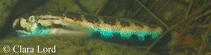
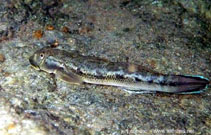
Spine dorsali (totale) : 6 - 7; Raggi dorsali molli (totale) : 9 - 10; Spine anali: 1; Raggi anali molli: 10. Usually 11 unsegmented rays in second dorsal fin. Pectoral rays usually 19. Predorsal midline usually with 13-16 cycloid scales, anterior scales smaller than those posteriorly. Scales on flanks same size as those on caudal peduncle. Belly always with fairly large cycloid scales, about the same size as those on the caudal peduncle. Caudal fin with blackish or dusky horseshoe-shaped band close to margin, medial rays blackish or dusky (Ref. 37578).
Body shape (shape guide): fusiform / normal.
Adults inhabit fast-flowing sections of clear rainforest streams over rocky bottoms (Ref. 44894). Hatching and larval stage occur at sea, postlarval stage to adult in freshwater (Ref. 4343, 79840). Commercial in Reunion, where they are caught during the few days when they return from sea to enter the rivers (Doug Fenner, pers. comm., 2002, Ref. 79840). Smallest gravid female reported 5.03 cm SL (Ref. 37578).
Females when ready to spawn wriggles under a loosely set stone. The eggs are spread into a flat mass as the fish holds fast to the under surface of a stone. The eggs are fastened to the stones by the gelatinous threads that cover them (Ref. 110258). The male ejects his milt on the mass of eggs (Ref. 110258).
Spawning occurs in freshwater afterwhich eggs and larvae are washed down by the river current into the sea and goes back up the river after a month or so (Ref. 110258). The embryo development occurs in freshwater and the larvae should migrate to saltwater a few days following hatching. The larvae are carried by current to the sea where they grow up to the juvenile stage ("bichique"). At this stage the alevins get to the rivers and start going upstream during the new moon. They can go up to waterfalls higher than 10 meters with the help of their sucker-disc, that they can colonize waters up to 800m altitude (Ref. 48660).
Maugé, L.A., 1986. Gobiidae. p. 358-388. In J. Daget, J.-P. Gosse and D.F.E. Thys van den Audenaerde (eds.) Check-list of the freshwater fishes of Africa (CLOFFA). ISNB, Brussels; MRAC, Tervuren; and ORSTOM, Paris. Vol. 2. (Ref. 4343)
Stato della Lista Rossa IUCN (Ref. 130435: Version 2025-2 (Global))
Minaccia per l'uomo
Harmless
Usi umani
Pesca: commerciale
Strumenti
Rapporti speciali
Scarica XML
Fonti Internet
Stime basate su modelli
Temperatura preferita (Fonte Biblio.
123201): 25.6 - 28.5, mean 26.9 °C (based on 319 cells).
Indice di diversità filogenetica (Fonte Biblio.
82804): PD
50 = 0.5000 [Uniqueness, from 0.5 = low to 2.0 = high].
Bayesian length-weight: a=0.01122 (0.00514 - 0.02450), b=3.04 (2.87 - 3.21), in cm total length, based on all LWR estimates for this body shape (Ref.
93245).
Livello trofico (Fonte Biblio.
69278): 2.8 ±0.31 se; based on food items.
Resilienza (Fonte Biblio.
120179): Alto, tempo minimo di raddoppiamento della popolazione meno di 15 mesi (Fec=46,000).
Vulnerabilità della pesca (Ref.
59153): Low vulnerability (10 of 100).
🛈
Nutrienti (Ref.
124155): Calcium = 314 [164, 772] mg/100g; Iron = 1.44 [0.79, 2.74] mg/100g; Protein = 17.9 [16.0, 19.5] %; Omega3 = 0.2 [0.1, 0.4] g/100g; Selenium = 24.7 [12.4, 51.7] μg/100g; VitaminA = 30.7 [9.3, 83.0] μg/100g; Zinc = 2.39 [1.64, 3.57] mg/100g (wet weight);