>
Carangiformes (Jacks) >
Carangidae (Jacks and pompanos) > Scomberoidinae
Etymology: Oligoplites: Greek, oligos = small + Greek, hoplites = armed (Ref. 45335).
More on author: Cuvier.
Meio ambiente: milieu / Zona climática / intervalo de profundidade / faixa de distribuição
Ecologia
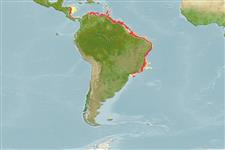
marinhas; Água doce; estuarina bentopelágico; intervalo de profundidade 18 - 45 m (Ref. 3277). Tropical; 16°N - 26°S, 89°W - 34°W
Western Atlantic: Lake Izabal, Guatemala eastward to Sao Paulo, Brazil.
Tamanho / Peso / Idade
Maturidade: Lm ? range ? - ? cm
Max length : 49.7 cm TL macho/indeterminado; (Ref. 9626); common length : 35.0 cm TL macho/indeterminado; (Ref. 9626); peso máx. publicado: 900.00 g (Ref. 9626)
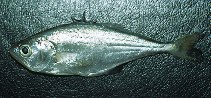
Adults are found mainly in brackish and fresh waters; also over muddy bottoms of coastal marine waters (Ref. 5217). May leap out of the water. They return to the sea to reproduce (Ref. 36880). Dorsal and anal spines bear venomous glands (Ref. 40401). Adults are carnivorous (Ref 40401) while juveniles up to 8.2 cm FL feed mainly on scales taken from larger fishes, also on benthic and planktonic crustaceans, and to a minor extent on smaller fishes and polychaetes (Ref. 40402). Juveniles up to 3.0 cm TL adopt a dark brown color pattern while close to decaying plant fragments, an example of camouflage (Ref. 40401, 46533). Over open, detritus-free and light colored sandy bottom, adopts a contrasting yellowish and dark brown pattern, an example of warning colors. Its conspicuous colors are mimicked by juveniles of the non-venomous grunt Pomadasys ramosus (Ref. 46533).
Ciclo de vida ou comportamento de acasalamento
Maturidade | Reprodução | Desova | Ovos | Fecundidade | Larvas
Cervigón, F., 1993. Los peces marinos de Venezuela. Volume 2. Fundación Científica Los Roques, Caracas,Venezuela. 497 p. (Ref. 9626)
Status na Lista Vermelha da UICN (Ref. 130435: Version 2025-2 (Global))
Uso pelos humanos
Pescarias: pouco comercial
Ferramentas
Relatórios especiais
Baixar XML
Fontes da internet
Estimativas baseadas em modelos
Temperatura preferida (Ref.
123201): 24.3 - 28, mean 27.3 °C (based on 60 cells).
Índice de diversidade filogenética (Ref.
82804): PD
50 = 0.5312 [Uniqueness, from 0.5 = low to 2.0 = high].
Bayesian length-weight: a=0.01047 (0.00582 - 0.01883), b=2.90 (2.75 - 3.05), in cm total length, based on LWR estimates for this species & Genus-body shape (Ref.
93245).
Nível Trófico (Ref.
69278): 4.3 ±0.5 se; based on diet studies.
Resiliência (Ref.
120179): médio(a), tempo mínimo de duplicação da população 1,4 - 4,4 anos (Preliminary K or Fecundity.).
Vulnerabilidade da pesca (Ref.
59153): Moderate vulnerability (40 of 100).
🛈