>
Gobiiformes (Gobies) >
Gobiidae (Gobies) > Gobiinae
Etymology: Porogobius: Greek, poros = porous + Latin, gobius = gudgeon (Ref. 45335).
Eponymy: Hermann Schlegel (1804–1884) was a German-born zoologist who spent much of his life in the Netherlands. [...] (Ref. 128868), visit book page.
More on author: Günther.
Ambiente: milieu / zona climática / intervalo de profundidade / gama de distribuição
Ecologia
marinhas; Água doce; estuarina demersal; anfídromo (Ref. 46888). Tropical
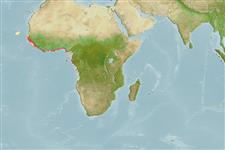
Africa: Senegal to Democratic Republic of the Congo (Ref. 7390, 57403, 79590, 80060). Also known from Cape Verde and islands in the Gulf of Guinea (Ref. 5299, 79590).
Tamanho / Peso / Idade
Maturidade: Lm ? range ? - ? cm
Max length : 18.9 cm TL macho/indeterminado; (Ref. 128374)
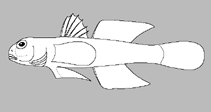
Espinhos dorsais (total) : 7; Raios dorsais moles (total) : 9 - 10; Espinhos anais: 1; Raios anais moles: 8 - 9. Diagnosis: each side of lower jaw with a recurved canine tooth approximately midway along its length (Ref. 57403). Outer row of teeth on lower jaw ending posteriorly in one or more long, recurved teeth (Ref. 79590). Angle of mouth reaching to below anterior margin of eye; 30-35 ctenoid scales in longitudinal series (including about 2-3 scales on caudal fin base), 9 scales in rearward transverse series; 1st dorsal fin: VI; 2nd dorsal fin: I,9 (infrequently 10); anal fin: I,8-9; pectoral fins: 19; pelvic fins just reaching to anus, relatively broad but with thin membrane between spines; caudal fin with 17 segmented rays (usually 14 of which are branched) (Ref. 57403, 79590).
Coloration: Preserved specimens: very pale (whitish in alcohol); body covered with numerous small, black spots, larger and more close-set on dorsum; lateral part of head with a dark band running in a crescent from above posterior tip of jaw up towards eye, continuing under ventral margin of eye, and extending posteriorly to dorsal edge of operculum; head with dark, median predorsal band; flanks, below lateral line, with several short vertical bars of fine black dots, darkest bars located at level of 2nd dorsal fin; pectoral fin with dark patch near base of upper rays; just posterior to this there is a band of dark pigment running posteroventrally down upper part of fin; lower, anterior part of pectoral fin bears a narrow, longitudinal, band of dark pigment; other parts of fin with fine black speckling; white longitudinal band along middle of each dorsal fin, and a black longitudinal band along middle of anal fin; pelvic fins with black pigment between rays; caudal fin speckled black, with some dark spots aligned in vertical or slightly oblique rows (Ref. 57403, 79590).
Body shape (shape guide): fusiform / normal.
Occurs inshore, in the intertidal zone (Ref. 4343), in brackish and freshwaters, particularly estuaries, coastal lagoons, mangrove swamps (Ref. 4343, 57403, 79590), creeks and lower river basins (Ref. 57403). Tolerant of fresh waters and may ascend rivers, although less common in these habitats; may establish burrows in subtidal mud (Ref. 79590). Feeds on fish, lamellibranchs, phytoplankton and detritus (Ref. 28587).
Ciclo de vida e comportamento de acasalamento
Maturidade | Reprodução | Desova | Ovos | Fecundidade | Larvas
Harrison, I.J., P.J. Miller and F. Pezold, 2003. Gobiidae. p. 625-666 In C. Lévêque, D. Paugy and G.G. Teugels (eds.) Faune des poissons d'eaux douce et saumâtres de l'Afrique de l'Ouest, Tome 2. Coll. Faune et Flore tropicales 40. Musée Royal de l'Afrique Centrale, Tervuren, Belgique, Museum National d'Histoire Naturalle, Paris, France and Institut de Recherche pour le Développement, Paris, France. 815 p. (Ref. 57403)
Categoria na Lista Vermelha da IUCN (Ref. 130435: Version 2025-2 (Global))
Ameaça para o homem
Harmless
Utilização humana
Ferramentas
Relatórios especiais
Descarregue XML
Fontes da internet
Estimativas baseadas em modelos
Temperatura preferida (Ref.
123201): 25.6 - 28, mean 27.4 °C (based on 163 cells).
Índice de diversidade filogenética (Ref.
82804): PD
50 = 1.0000 [Uniqueness, from 0.5 = low to 2.0 = high].
Bayesian length-weight: a=0.00776 (0.00488 - 0.01236), b=3.05 (2.92 - 3.18), in cm total length, based on LWR estimates for this species & (Sub)family-body (Ref.
93245).
Nível Trófico (Ref.
69278): 2.9 ±0.38 se; based on food items.
Resiliência (Ref.
120179): Médio, tempo mínimo de duplicação da população 1,4 - 4,4 anos (Preliminary K or Fecundity.).
Vulnerabilidade da pesca (Ref.
59153): Low vulnerability (10 of 100).
🛈
Nutrientes (Ref.
124155): Calcium = 287 [156, 628] mg/100g; Iron = 1.26 [0.69, 2.39] mg/100g; Protein = 17.4 [15.5, 18.9] %; Omega3 = 0.155 [0.065, 0.317] g/100g; Selenium = 42.7 [21.4, 102.3] μg/100g; VitaminA = 26.8 [8.9, 71.3] μg/100g; Zinc = 2.14 [1.50, 3.10] mg/100g (wet weight);