>
Gobiiformes (Gobies) >
Gobiidae (Gobies) > Gobiinae
Etymology: Mauligobius: From Maul, ichthyiologist that studied the fishes from Madeira and Canary Islands + Latin, gobius = gudgeon (Ref. 45335).
Eponymy: Günther Edmund Maul (1909–1997) was a German ichthyologist and taxidermist who lived and worked most of his life in Madeira. [...] This is a toponym referring to the River Niger; the river (or its mouth, in the case of marine species) being the type locality. (Ref. 128868), visit book page.
More on author: Günther.
Ambiente: milieu / zona climatica / distribuzione batimetrica / gamma di distribuzione
Ecologia
marino; salmastro demersale. Tropical
Eastern Atlantic: Nigeria to Equatorial Guinea and offshore islands (Ref. 4343, 79590). Also collected from Banana (Congo River estuary), Democratic Republic of the Congo (Ref. 31982). The lack of reliable data for West African specimens suggest that it might be restricted to the Cape Verde Islands (Ref. 57403, 79590).
Dimensione / Peso / Età
Maturità: Lm ? range ? - ? cm
Max length : 7.0 cm SL maschio/sesso non determinato; (Ref. 79590)
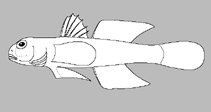
Spine dorsali (totale) : 7; Raggi dorsali molli (totale) : 10; Spine anali: 1; Raggi anali molli: 8 - 9. Diagnosis: anterior nostril with rim process divided into several tentacles (Ref. 39517, 57403, 79590). Scales on lower cheek and operculum; 40-46 ctenoid scales in longitudinal series (including about 4-6 scales on the caudal fin base), and 15-17 in rearward transverse series; 1st dorsal fin: VI; second dorsal fin: I,10; anal fin: I,8-9; pectoral fins: 24-26, outer (dorsal) 9-10 rays short, multifid and free from membrane (Ref. 57403, 79590). Anal fin base shorter than caudal peduncle (Ref. 39517).
Coloration: Preserved specimens: head with dark mottling (Ref. 39517, 57403, 79590). Body dark, with about a dozen small spots along the lateral midline (Ref. 39517, 57403, 79590), darker in color than the background pigmentation (Ref. 57403), but lacking vertical dark bars (Ref. 39517). 1st and 2nd dorsal fins with 2-3 oblique rows of small white spots; pelvic fins/disc paler than other fins (Ref. 39517, 57403, 79590). In life: body chestnut-brown , with dorsal, caudal and pectoral fins spotted with brown; anal and pelvic fins blackish (Ref. 57403, 79590).
Body shape (shape guide): fusiform / normal.
Occurs inshore (Ref. 4343). Although possibly entering estuaries, this species is more likely a benthic inhabitant (Ref. 57403, 79590) of marine intertidal zones (Ref. 27000, 57403, 79590). Collected in shallow water among large lava-pebbles under strong wave action, and smaller examples came from a boundary area between rocks and sand at 2-4m depth (Ref. 39517). Maximum total length reported 8.7 cm (Ref. 57403).
Ciclo vitale e comportamento di accoppiamento
Maturità | Riproduzione | Deposizione | Uova | Fecondità | Larve
Harrison, I.J., P.J. Miller and F. Pezold, 2003. Gobiidae. p. 625-666 In C. Lévêque, D. Paugy and G.G. Teugels (eds.) Faune des poissons d'eaux douce et saumâtres de l'Afrique de l'Ouest, Tome 2. Coll. Faune et Flore tropicales 40. Musée Royal de l'Afrique Centrale, Tervuren, Belgique, Museum National d'Histoire Naturalle, Paris, France and Institut de Recherche pour le Développement, Paris, France. 815 p. (Ref. 57403)
Stato della Lista Rossa IUCN (Ref. 130435: Version 2025-2 (Global))
Minaccia per l'uomo
Harmless
Usi umani
Pesca: di nessun interesse
Strumenti
Rapporti speciali
Scarica XML
Fonti Internet
Stime basate su modelli
Indice di diversità filogenetica (Fonte Biblio.
82804): PD
50 = 0.7500 [Uniqueness, from 0.5 = low to 2.0 = high].
Bayesian length-weight: a=0.01023 (0.00477 - 0.02194), b=3.01 (2.83 - 3.19), in cm total length, based on LWR estimates for this (Sub)family-body shape (Ref.
93245).
Livello trofico (Fonte Biblio.
69278): 3.3 ±0.3 se; based on size and trophs of closest relatives
Resilienza (Fonte Biblio.
120179): Alto, tempo minimo di raddoppiamento della popolazione meno di 15 mesi (Preliminary K or Fecundity.).
Vulnerabilità della pesca (Ref.
59153): Low vulnerability (10 of 100).
🛈