>
Gobiiformes (Gobies) >
Gobiidae (Gobies) > Gobiinae
Etymology: Gobiodon: Latin, gobius = gudgeon + Greek, odous = teeth (Ref. 45335).
More on author: Rüppell.
Ambiente: milieu / zona climática / intervalo de profundidade / gama de distribuição
Ecologia
marinhas; Água doce; estuarina associadas(os) a recifes; anfídromo (Ref. 46888); intervalo de profundidade 0 - 78 m (Ref. 86942). Tropical; 30°N - 24°S
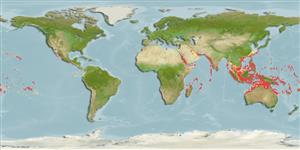
Indo-West Pacific: Red Sea and East Africa to the Tuamoto Islands, north to the Ryukyu Islands.
Tamanho / Peso / Idade
Maturidade: Lm ? range ? - ? cm
Max length : 6.4 cm TL macho/indeterminado; (Ref. 116275)
Descrição breve
Chaves de identificação | Morfologia | Morfometria
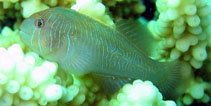
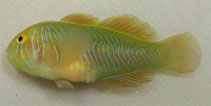
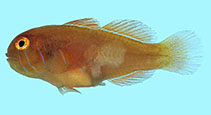
Espinhos dorsais (total) : 7; Raios dorsais moles (total) : 10 - 11; Espinhos anais: 1; Raios anais moles: 8 - 9. Characterized by red face with vertical blue lines; uniformly dark brown to light brown or bright green with a longitudinal thin red stripe; red stripe at the base of dorsal fins; absence of scales; complete pelvic fin frenum and basal membrane; depth of body at level of pelvic fins 2.6-3.0 in SL (Ref. 90102).
Body shape (shape guide): short and / or deep; Cross section: compressed.
Facultative air-breathing in the genus (Ref. 126274); Marine species usually living on coral reefs but also recorded from pools, freshwater streams or lagoon mouths (Ref. 4343). They are found on tabletop Acropora corals (Ref. 1602); a coral-commensal species (Ref. 72446). Adults prey on copepods (Ref. 92840). Monogamous (Ref. 52884). The male takes care of eggs deposited on a coral branch (Ref. 32163). Has the ability to change sex in both directions to favor reproductive success (Ref. 32163).
Ciclo de vida e comportamento de acasalamento
Maturidade | Reprodução | Desova | Ovos | Fecundidade | Larvas
The male takes care of eggs deposited on a coral branch (Ref. 32163). Has the ability to change sex in both directions to favor reproductive success (Ref. 32163). Monogamous mating is observed as both obligate and social (Ref. 52884).
Hoese, D.F., 1986. Gobiidae. p. 774-807. In M.M. Smith and P.C. Heemstra (eds.) Smiths' sea fishes. Springer-Verlag, Berlin. (Ref. 2798)
Categoria na Lista Vermelha da IUCN (Ref. 130435: Version 2025-2 (Global))
Ameaça para o homem
Harmless
Utilização humana
Pescarias: espécies comerciais; Aquário: Espécies comerciais
Ferramentas
Relatórios especiais
Descarregue XML
Fontes da internet
Estimativas baseadas em modelos
Temperatura preferida (Ref.
123201): 24.8 - 29, mean 28 °C (based on 1316 cells).
Índice de diversidade filogenética (Ref.
82804): PD
50 = 0.5000 [Uniqueness, from 0.5 = low to 2.0 = high].
Bayesian length-weight: a=0.01995 (0.00906 - 0.04395), b=3.01 (2.83 - 3.19), in cm total length, based on all LWR estimates for this body shape (Ref.
93245).
Nível Trófico (Ref.
69278): 3.5 ±0.5 se; based on size and trophs of closest relatives
Resiliência (Ref.
120179): Elevada, tempo mínimo de duplicação da população menor que 15 meses (Preliminary K or Fecundity.).
Vulnerabilidade da pesca (Ref.
59153): Low vulnerability (10 of 100).
🛈
Nutrientes (Ref.
124155): Calcium = 183 [75, 391] mg/100g; Iron = 1.01 [0.49, 2.17] mg/100g; Protein = 18.1 [16.1, 20.0] %; Omega3 = 0.153 [0.054, 0.335] g/100g; Selenium = 30.4 [12.2, 70.7] μg/100g; VitaminA = 81.6 [18.2, 361.1] μg/100g; Zinc = 2.55 [1.57, 3.97] mg/100g (wet weight);