>
Gobiiformes (Gobies) >
Gobiidae (Gobies) > Gobionellinae
Etymology: Gnatholepis: Greek, gnathos = jaw + Greek,lepis = scale (Ref. 45335).
More on author: Bleeker.
Entorno: milieu / zona climática / rango de profundidad / gama de distribución
Ecología
marino; salobre asociado a arrecife; rango de profundidad 2 - 50 m (Ref. 90102), usually 2 - 20 m (Ref. 27115). Tropical; 30°N - 28°S
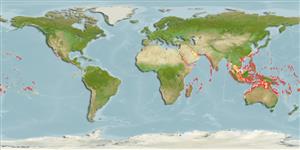
Indo-Pacific: widespread from South Africa to Pitcairn I.; in the Pacific north to Miyake-jima, Japan, south to Sydney Harbour, Australia; in the Indian Ocean north to Djibouti (Gulf of Tadjourah) and south to Aliwal Shoal, Kwa-Zulu Natal.
Tamaño / Peso / Edad
Madurez: Lm ? range ? - ? cm
Max length : 6.0 cm SL macho / no sexado; (Ref. 48637)
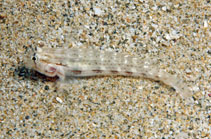
Espinas dorsales (total) : 7; Radios blandos dorsales (total) : 11; Espinas anales: 1; Radios blandos anales: 11. Distinguished by the following characteristics: moderate-sized (up to 56 mm SL) with wide range in live colour pattern; ctenoid body scales usually reaching rear corner of opercle, occasionally ctenoid scales reaching to above rear preopercular margin; nape midline scales always cycloid, distinct flap present at end of lower lip; when alive, colour variable: body translucent white with five to seven rows of small variably coloured (dull orange, brown, red-brown to blackish) spots and/or thin lines and about six indistinct diffuse orange-brown to purple-brown blotches along midside; narrow vertical black mark on top of each eye, marks may join each other across interorbital space, and narrow black vertical line crossing cheek below eye; small dark mark of variable shape (often W-shaped) above pectoral fin base, with small yellow spot in centre; second dorsal and anal fin rays usually I,11; pectoral rays 12-18, modally 16; lateral scales 24-30, modally 27; 7-12 predorsal scales (modally 9) (Ref. 92171).
Body shape (shape guide): fusiform / normal; Cross section: oval.
A common species that occurs in sheltered sandy areas from reef flats to seaward reefs; over sandy bottoms near pieces of rubble, rock, or coral (live or dead) (Ref. 9710, 48637, 92171). Solitary or in small groups (Ref. 90102). Feeds on algae, detritus and small benthic invertebrates (Ref. 89972).
Ciclo vital y comportamiento de apareamiento
Madurez | Reproducción | Puesta | Huevos | Fecundidad | Larva
Larson, H.K. and D.J. Buckle, 2012. A revision of the goby genus Gnatholepis Bleeker (Teleostei, Gobiidae, Gobionellinae), with description of a new species. Zootaxa 3529:1-69. (Ref. 92171)
Situación en la Lista Roja de la UICN (Ref. 130435: Version 2025-2 (Global))
Amenaza para el ser humano
Harmless
Usos humanos
Pesquerías: comercial; Acuario: Comercial
Herramientas
Informes especiales
Descargar XML
Fuentes de Internet
Estimaciones basadas en modelos
Temperatura preferida (Referencia
123201): 24.7 - 28.9, mean 27.6 °C (based on 774 cells).
Índice de diversidad filogenética (Referencia
82804): PD
50 = 0.5010 [Uniqueness, from 0.5 = low to 2.0 = high].
Bayesian length-weight: a=0.01023 (0.00452 - 0.02316), b=3.00 (2.81 - 3.19), in cm total length, based on LWR estimates for this (Sub)family-body shape (Ref.
93245).
Nivel trófico (Referencia
69278): 2.3 ±0.0 se; based on diet studies.
Resiliencia (Referencia
120179): Alto, población duplicada en un tiempo mínimo inferior a 15 meses (Preliminary K or Fecundity.).
Vulnerabilidad pesquera (Ref.
59153): Low vulnerability (10 of 100).
🛈
Nutrientes (Ref.
124155): Calcium = 173 [83, 398] mg/100g; Iron = 1.01 [0.47, 1.99] mg/100g; Protein = 18.2 [16.2, 19.9] %; Omega3 = 0.164 [0.069, 0.322] g/100g; Selenium = 23.8 [11.4, 62.9] μg/100g; VitaminA = 122 [29, 448] μg/100g; Zinc = 3.25 [2.10, 4.97] mg/100g (wet weight);