>
Carangiformes (Jacks) >
Carangidae (Jacks and pompanos) > Caranginae
Etymology: Decapterus: Greek, deka = ten + Greek, pteron = wing, fin (Ref. 45335).
Umwelt: Milieu / Klimazone / Tiefenbereich / Verbreitungsgebiet
Ökologie
seewasser demersal; tiefenbereich 7 - 550 m (Ref. 47377), usually 150 - 220 m (Ref. 5217). Subtropical; 45°N - 55°S, 102°E - 41°E
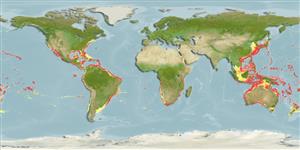
Pacific Ocean: Japan, Indonesia (Ref. 3197), Australia and the Hawaiian Islands Western Atlantic: Canada (Ref. 5951) to North Carolina, USA to Venezuela (Ref. 7251). Also found in Brazil (Ref. 47377) and in Argentina (Ref. 2806). Eastern Atlantic: St. Helena Island (Ref. 7097). Indian Ocean: off Kenya (Ref. 3287) to off East London, South Africa (Ref. 11228).
Länge bei der ersten Reifung / Größe / Gewicht / Alter
Geschlechtsreife: Lm 30.0 range ? - ? cm
Max length : 50.0 cm TL Männchen/unbestimmt; (Ref. 3197); common length : 25.0 cm TL Männchen/unbestimmt; (Ref. 5217); max. veröff. Gewicht: 560.00 g (Ref. 3277)
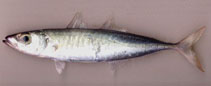
Rückenflossenstacheln (insgesamt) : 9; Rückenflossenweichstrahlen (insgesamt) : 30 - 34; Afterflossenstacheln: 3; Afterflossenweichstrahlen: 24 - 26; Wirbelzahl: 24. This species is distinguished by the following: posterodorsal margin of opercular membrane minutely serrated in adults; oral valve (membrane) at symphysis of upper jaw dusky or transparent; posterior end of upper jaw straight above, slightly concave and not strongly slanted anteroventrally; shoulder girdle (cleithrum) margin with 2 small papillae, the lower papilla larger; terminal dorsal- and anal-fin rays each consisting of a widely detached finlet; lateral line scales, in curved part 61-73, no scutes and straight part 4-12, followed by 30-40 scutes; total scales and scutes in lateral line (excluding scales on caudal fin) 103-118. Colour in life metallic blue to greenish above, silvery below; small black blotch on margin of opercle near upper edge; caudal fin bright red and tips of soft dorsal-fin rays tinged with red (Ref. 9894, 11228).
Body shape (shape guide): fusiform / normal; Cross section: oval.
Adults occur in mid-water or near the bottom; also near the surface (Ref. 5217). They feed on smaller planktonic invertebrates, primarily copepods. Maximum depth recorded from Ref. 57551. Marketed fresh (Ref. 5217).
Paxton, J.R., D.F. Hoese, G.R. Allen and J.E. Hanley, 1989. Pisces. Petromyzontidae to Carangidae. Zoological Catalogue of Australia, Vol. 7. Australian Government Publishing Service, Canberra, 665 p. (Ref. 7300)
IUCN Rote Liste Status (Ref. 130435: Version 2025-2 (Global))
Bedrohung für Menschen
Harmless
Nutzung durch Menschen
Fischereien: weniger kommerziell; Köder: usually
Tools
Zusatzinformationen
Download XML
Internet Quellen
Schätzungen auf der Grundlage von Modellen
Bevorzugte Temperatur (Ref.
123201): 12.1 - 22.4, mean 16.6 °C (based on 271 cells).
Phylogenetischer Diversitätsindex (Ref.
82804): PD
50 = 0.5005 [Uniqueness, from 0.5 = low to 2.0 = high].
Bayesian length-weight: a=0.01230 (0.00829 - 0.01826), b=3.02 (2.90 - 3.14), in cm total length, based on LWR estimates for this species & Genus-body shape (Ref.
93245).
Trophische Ebene (Ref.
69278): 3.2 ±0.32 se; based on food items.
Widerstandsfähigkeit (Ref.
120179): hoch, Verdopplung der Population dauert weniger als 15 Monate. (K=0.97; Fec=20,000-150,000).
Anfälligkeit der Fischerei (Ref.
59153): Moderate vulnerability (40 of 100).
🛈