>
Ovalentaria/misc (Various families in series Ovalentaria) >
Polycentridae (Leaffishes)
Etymology: Polycentropsis: Greek, poly = a lot of + Greek, kentron = sting + Greek, opsis = appearance (Ref. 45335).
More on author: Boulenger.
Lingkungan: lingkungan / zona iklim / kisaran kedalaman / jangkauan distribusi
Ekologi
; air tawar bentopelagis; pH range: 6.0 - 6.5; dH range: 10 - ?. Tropical; 26°C - 30°C (Ref. 2059)
Africa: in West Africa from the eastern side of the Ouémé (Benin) to the Cross River (Nigeria), including the lower course and delta of the Niger River (Ref. 57397). Also found in coastal parts of the rivers Meme, Wouri, Sanaga and Lokoundje in Cameroon and in the Komo and Ogowe basins in Gabon (Ref. 81649).
Ukuran / Berat / umur
Kematangan: Lm ? range ? - ? cm
Max length : 6.7 cm SL jantan/; (Ref. 81649)
deskripsi pendek
Kunci identifiaksi (pengenalan) | Morfologi | Morfometrik
Duri punggung (Keseluruhan (total)) : 15 - 17; duri punggung lunak (Keseluruhan (total)) : 9 - 11; Duri dubur: 9 - 12; Sirip dubur lunak: 8 - 9; vertebrata, bertulang belakang: 23. Diagnosis: 6-7 scale rows on cheeks; lateral line incomplete; caudal peduncle very short; caudal fin truncate (Ref. 57397). Usually a pored lateral line is lacking, but if present, only 4-6 scales of dorsally curving series pored; 16 principal caudal rays with 1 procurrent ray on each lobe; 1st pelvic ray with anterior and posterior branches projecting a little beyond fin membrane; caudal peduncle conspicuously short; 10 abdominal and 13 caudal vertebrae; 3 predorsal bones (supraneurals) in front of 1st dorsal pterygiophore (Ref. 81649).
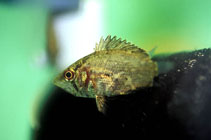
Coloration: dull brown; head and sides with irregular dark brown/black spots sometimes forming a marbled pattern (Ref. 57397; 81649). Dark band from anterior base of dorsal fin through eye to snout tip; second dark band from ventrocaudal margin of eye ventrocaudally over cheek to ventral side of body anterior to pelvic fin base; distal parts of soft dorsal and anal fin, caudal and pectoral fins transparent; pelvics and spinous part and base of soft dorsal and anal fins brown (Ref. 81649). Fins seeming rayless when viewed form certain angles (Ref. 57397).
Body shape (shape guide): fusiform / normal; Cross section: compressed.
Occurs in rainforest areas (Ref. 6801). Maximum reported TL was 8.0 cm (Ref. 6801).
Siklus hidup dan perilaku kawin
Kematangan | Reproduksi, perkembang biakan | Pemijahan | telur-telur | Fekunditas | Larva
Teugels, G.G., 2003. Nandidae. p. 516-519 In C. Lévêque, D. Paugy and G.G. Teugels (eds.) Faune des poissons d'eaux douce et saumâtres de l'Afrique de l'Ouest, Tome 2. Coll. Faune et Flore tropicales 40. Musée Royal de l'Afrique Centrale, Tervuren, Belgique, Museum National d'Histoire Naturalle, Paris, France and Institut de Recherche pour le Développement, Paris, France. 815 p. (Ref. 57397)
Status IUCN Red List (Ref. 130435: Version 2025-2 (Global))
ancaman kepada manusia
Harmless
penggunaan manusia
Budidaya air: komersial; Akuarium: Komersial
Alat, peralatan
laporan khas
muat turun XML
Sumber internet
Estimasi berdasarkan model
Indeks keanekaragaman filogenetik (Acuan
82804): PD
50 = 1.0312 [Uniqueness, from 0.5 = low to 2.0 = high].
Bayesian length-weight: a=0.02042 (0.00795 - 0.05244), b=3.02 (2.80 - 3.24), in cm total length, based on LWR estimates for this (Sub)family-body shape (Ref.
93245).
Tingkat Trofik (Acuan
69278): 3.8 ±0.6 se; based on size and trophs of closest relatives
Kerentanan Penangkapan Ikan (Ref.
59153): Low vulnerability (10 of 100).
🛈