>
Siluriformes (Catfishes) >
Clariidae (Airbreathing catfishes)
Etymology: Clarias: Greek, chlaros = lively, in reference to the ability of the fish to live for a long time out of water.
More on author: Boulenger.
Environnement : milieu / zone climatique / profondeur / gamme de distribution
Écologie
; eau douce démersal. Tropical; 3°N - 10°S
Africa: Sanaga and Kribi in Cameroon, Ntem in Cameroon and Gabon, Mbini/Woleu and Ogowe in Gabon (Ref. 81644). Widespread in the lower and middle Congo River basin (Ref. 78218). Also reported from the Wagenia Falls and Lualaba/upper Congo (Ref. 106245). Also in the Chiloango drainage (Ref. 78218), but latter unconfirmed in Ref. 81644.
Taille / Poids / Âge
Maturité: Lm ? range ? - ? cm
Max length : 37.6 cm TL mâle / non sexé; (Ref. 3820)
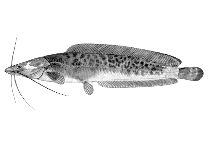
Rayons mous dorsaux (Total) : 72 - 83; Rayons mous anaux: 56 - 65; Vertèbres: 59 - 63. Diagnosis: head length 24.5-28.4% SL (Ref. 81644, 101841). Head broad, long and flattened, rectangularly outlined in dorsal view (Ref. 248), its width 17.4-21.9% SL (Ref. 81644). Eyes lateral; postorbital bones in contact (Ref. 81644). Interorbital distance 42.6-51.8% HL (Ref. 81644, 101841). Tooth plates extremely large (Ref. 248), width of premaxillary tooth plate 32.4-40.0% HL, and of vomerine tooth plate 26.4-36.2% HL (Ref. 101841). Frontal fontanelle somewhat intermediate between `sole-shaped' and `knife-shaped'; occipital fontanelle oval-shaped (Ref. 248). Pectoral spine straight (Ref. 248), strongly serrate on anterior margin only (Ref. 81644). 14 or fewer gill rakers (Ref. 101841), which are short and widely separated (Ref. 248). Supra-branchial organ consists of well-developed arborescent structures but not completely filling the cavity (Ref. 248). Dorsal fin length 60.4-65.6% SL; distance from dorsal to caudal fin 1.6-3.7% SL (Ref. 101841). Flank neuromasts arranged in a regular pattern (Ref. 81644).
Colouration: both in life and in preservation colouration is marbled: large irregular black blotches on a pale brown base present on back, flanks, dorsal and anal fins, and on posterior/upper side of paired fins; ventrum and lower parts of paired fins beige, as are distal parts of unpaired fins; caudal fin bears a series of pale and dark bands (Ref. 248, 81644, 101841). Never an irregular pattern of small white spots on body (Ref. 101841).
Body shape (shape guide): elongated; Cross section: oval.
Facultative air-breathing (Ref. 126274); Restricted to equatorial forest and galley forest rivers (Ref. 248). Inhabits smaller rivers, ditches and inundation zones (Ref. 78218). Feeds on fish (Ref. 248, 78218).
Cycle de vie et comportement reproducteur
Maturité | Reproduction | Frai | Œufs | Fécondité | Larves
Teugels, G.G., 1986. A systematic revision of the African species of the genus Clarias (Pisces; Clariidae). Ann. Mus. R. Afr. Centr., Sci. Zool., 247:199 p. (Ref. 248)
Statut dans la liste rouge de l'IUCN (Ref. 130435: Version 2025-2 (Global))
Menace pour l'homme
Harmless
Utilisations par l'homme
Outils
Articles particuliers
Télécharger en XML
Sources Internet
Estimations basées sur des modèles
Indice de diversité phylogénétique (Réf.
82804): PD
50 = 0.5000 [Uniqueness, from 0.5 = low to 2.0 = high].
Bayesian length-weight: a=0.00776 (0.00372 - 0.01620), b=2.96 (2.79 - 3.13), in cm total length, based on LWR estimates for this Genus-body shape (Ref.
93245).
Niveau trophique (Réf.
69278): 4.2 ±0.73 se; based on food items.
Résilience (Réf.
120179): Milieu, temps minimum de doublement de population : 1,4 à 4,4 années (Preliminary K or Fecundity.).
Vulnérabilité de la pêche (Ref.
59153): Low to moderate vulnerability (28 of 100).
🛈