>
Cyprinodontiformes (Rivulines, killifishes and live bearers) >
Nothobranchiidae (African rivulines)
Etymology: Nothobranchius: Greek, nothos = false + Greek, brangchia = gill (Ref. 45335).
Eponymy: Dr Reginald Arthur ‘Rex’ Jubb (1905–1987) was a South African ichthyologist whose bachelor’s degree was awarded by Rhodes University, Grahamstown, which also awarded him a DSc. [...] (Ref. 128868), visit book page.
Environnement : milieu / zone climatique / profondeur / gamme de distribution
Écologie
; eau douce benthopélagique; non migrateur. Tropical; 24°C - 26°C (Ref. 2060)
Africa: lower Tana and Sabaki river drainages in eastern Kenya and Juba river drainage in southern Somalia (Ref. 27139). Reported from the Wabi Shebele basin in Ethiopia (Ref. 58460).
Taille / Poids / Âge
Maturité: Lm ? range ? - ? cm
Max length : 6.0 cm TL mâle / non sexé; (Ref. 27139)
It occurs in temporary pools, swamps and ditches or rain pans, usually without connection to river courses (Ref. 30558). The adults die when waterbodies dry out with low rainfall (Ref. 30558). Males display to attract ripe females, pair off and spawn, grasping the female by folding over the large dorsal and anal fins (Ref. 30558). Spawning occurs daily for an extended period with a few eggs laid at a time (Ref. 30558). It is a bottom spawner (Ref. 27139, Ref. 30558) and development is suspended when the water bodies dry out (Ref. 30558). The eggs hatch the following rainy season when the pan fills, the fish growing to maturity in a few weeks (Ref. 30558). It are aggressive predators on insects and other aquatic invertebrates (Ref. 30558); therefore it is used for mosquito larva control (Ref. 30558). It is easy to maintain in the aquarium (Ref. 27139) and thus a popular aquarium fish (Ref. 30558).
Cycle de vie et comportement reproducteur
Maturité | Reproduction | Frai | Œufs | Fécondité | Larves
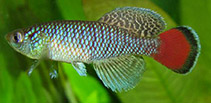
Males display to attract ripe females, pair off and spawn, grasping the female by folding over the large dorsal and anal fins; spawning occurs daily for an extended period; few eggs are laid at a time; eggs are laid in the bottom sediments and development is suspended when the waterbodies dry out; eggs can endure dessication; eggs hatch the following rainy season when the pan fills, fish growing to maturity in a few weeks; males grow larger than females and are brightly colored; usually complete their life within a year (Ref. 30558).
Wildekamp, R.H., R. Romand and J.J. Scheel, 1986. Cyprinodontidae. p. 165-276. In J. Daget, J.-P. Gosse and D.F.E. Thys van den Audenaerde (eds.) Check-list of the freshwater fishes of Africa (CLOFFA). ISNB, Brussels, MRAC; Tervuren; and ORSTOM, Paris. Vol. 2. (Ref. 3788)
Statut dans la liste rouge de l'IUCN (Ref. 130435: Version 2025-2 (Global))
Menace pour l'homme
Harmless
Utilisations par l'homme
Pêcheries: commercial; Aquarium: Commercial
Outils
Articles particuliers
Télécharger en XML
Sources Internet
Estimations basées sur des modèles
Indice de diversité phylogénétique (Réf.
82804): PD
50 = 0.5000 [Uniqueness, from 0.5 = low to 2.0 = high].
Bayesian length-weight: a=0.00603 (0.00250 - 0.01453), b=3.13 (2.93 - 3.33), in cm total length, based on LWR estimates for this (Sub)family-body shape (Ref.
93245).
Niveau trophique (Réf.
69278): 3.2 ±0.40 se; based on food items.
Résilience (Réf.
120179): Haut, temps minimum de doublement de population inférieur à 15 mois (tm<1).
Vulnérabilité de la pêche (Ref.
59153): Low vulnerability (10 of 100).
🛈