Klassifizierung / Names
Namen | Synonyme | Catalog of Fishes(Gattung, Arten) | ITIS | CoL | WoRMS | Cloffa
>
Cypriniformes (Carps) >
Leuciscidae (Minnows) > Leuciscinae
Eponymy: Professor Alessandro Ghigi (1875–1970) was Rector of Bologna University (1930–1943) where he had gained his first degree and doctorate (1902) as well as becoming Professor of Zoology there (1922) and Director of its Institute of Zoology. [...] (Ref. 128868), visit book page.
Taxonomic Remarks
In Ladigesocypris in CofF. Needs further work for confirmation.
Umwelt: Milieu / Klimazone / Tiefenbereich / Verbreitungsgebiet
Ökologie
; süßwasser benthopelagisch; pH range: 7.0 - 7.5; dH range: ? - 18. Subtropical; 5°C - 30°C (Ref. 13614); 37°N - 36°N
Europe: Rhodos Island in Greece. Records from Turkey refer to Ladigesocypris irideus (from Bergama to Dalaman) and Ladigesocypris mermere (Lake Marmara).
Größe / Gewicht / Alter
Geschlechtsreife: Lm ? range ? - ? cm
Max length : 6.5 cm SL Männchen/unbestimmt; (Ref. 13373); 9.0 cm SL (female); max. veröff. Alter: 3.00 Jahre (Ref. 40061)
Kurzbeschreibung
Bestimmungsschlüssel | Morphologie | Morphometrie
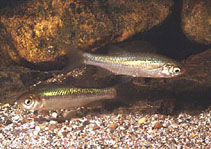
Diagnosed from other cyprinids in southeastern Europe by the possession of the following characters: incomplete lateral line, with perforating 11-17 scales; 27-23 total scales in midlateral row; dorsal fin with 6-8½ branched rays; anal fin with 7-9½ branched rays; broad dark midlateral stripe from head to caudal base, separating dark brown back from white belly (Ref. 59043).
Body shape (shape guide): fusiform / normal.
A short-lived species which inhabits lakes, rivers, springs, and associated wetlands (Ref. 26100). Found in slow-flowing stretches of streams, especially roots of trees, bank cavities and among vegetation. Larvae occur along banks among vegetation. Feeds on aquatic invertebrates and algae, mainly on plant material in summer. Juveniles and adults die in large number during summer and autumn drought. Spawns among aquatic vegetation, especially filamentous algae. Threatened due to water abstraction in dry season and habitat destruction (Ref. 59043).
A fractional spawner. Eggs are adhesive, 1.3 mm in diameter and hatch in 4 days (Ref. 59043).
Bogutskaya, N.G., 1996. Contribution to the knowledge of leuciscine fishes of Asia Minor. Part 1. Morphology and taxonomic relationships of Leuciscus borysthenicus (Kessler, 1859), L. smyrnaeus Boulenger, 1896 and Ladigesocypris ghigii (Gianferrari, 1927). Publ. Espec. Inst. Esp. Oceanogr. 21:25-44. (Ref. 13373)
IUCN Rote Liste Status (Ref. 130435: Version 2025-2 (Global))
Bedrohung für Menschen
Harmless
Nutzung durch Menschen
Fischereien: nicht kommerziell
Tools
Zusatzinformationen
Download XML
Internet Quellen
Schätzungen auf der Grundlage von Modellen
Phylogenetischer Diversitätsindex (Ref.
82804): PD
50 = 0.5000 [Uniqueness, from 0.5 = low to 2.0 = high].
Bayesian length-weight: a=0.00977 (0.00671 - 0.01423), b=3.17 (3.06 - 3.28), in cm total length, based on LWR estimates for this species & Genus-body shape (Ref.
93245).
Trophische Ebene (Ref.
69278): 2.7 ±0.24 se; based on food items.
Widerstandsfähigkeit (Ref.
120179): hoch, Verdopplung der Population dauert weniger als 15 Monate. (tmax=3).
Anfälligkeit der Fischerei (Ref.
59153): Low vulnerability (10 of 100).
🛈