>
Scombriformes (Mackerels) >
Scombridae (Mackerels, tunas, bonitos) > Scombrinae
Etymology: Euthynnus: Greek, eu = good + Greek, thynnos = tunna (Ref. 45335).
पर्यावरण: पर्यावरण / जलवायु क्षेत्र / गहराई सीमा / वितरण सीमा
पारिस्थितिकी
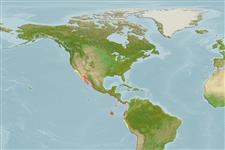
समुद्री pelagic-oceanic; औशिनोड़िरोमस (Ref. 51243); गहराई सीमा 0 - 40 m (Ref. 5227). Tropical; 39°N - 16°S, 128°W - 77°W (Ref. 168)
Eastern Pacific: off San Simeon, California, USA southward to the Galapagos Islands and northern Peru. Two stray specimens collected in the Hawaiian Islands.
आकार / वज़न / आयु
परिपक्व अवधि: Lm ? range ? - ? cm
Max length : 84.0 cm FL पुल्लिंग / अलिंग; (Ref. 168); common length : 60.0 cm FL पुल्लिंग / अलिंग; (Ref. 9340); अधिकतम प्रकाशित वज़न: 9.1 kg (Ref. 168)
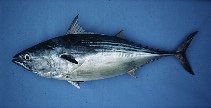
पृष्ठीय रीढ़ (सम्पूर्ण) : 10 - 15; ऐनल सौफट रेज़: 11 - 12; जानवरों की रीड़ का जोड़: 37. Anterior spines of first dorsal fin much higher than those mid-way, giving the fin a strongly concave outline. Interpelvic process small and bifid. Body naked except for corselet and lateral line. Swim bladder absent. A large rounded protuberances on 31st and 32nd vertebrae. Color is generally iridescent blue with black dorsal markings composed of 3 to 5 horizontal stripes. Also with variable black or dark gray spots above the pelvic fins. Occasionally with extensive longitudinal stripes of light gray on belly; some individuals have few or no belly markings.
Body shape (shape guide): fusiform / normal; Cross section: oval.
Occurs rarely where surface temperatures fall below 23°C. Its larvae are more frequently encountered at temperatures above 26°C and are practically confined to waters within about 240 miles off the mainland. Inhabits near the surface of coastal waters and offshore waters (Ref. 11035). Form multi-species schools with Thunnus albacares and Katsuwonus pelamis. An opportunistic predator which shares feeding pattern with other tunas and probably compete for food with other species such as yellowfin tuna, common dolphin, oriental bonito, among others.
जीवन चक्र और संभोग व्यवहार
परिपक्व अवधि | पुनरुत्पत्ति | मछलीऔ का अंडे देना | अंडे | उपजाऊपन | लार्वा
Collette, B.B. and C.E. Nauen, 1983. FAO Species Catalogue. Vol. 2. Scombrids of the world. An annotated and illustrated catalogue of tunas, mackerels, bonitos and related species known to date. Rome: FAO. FAO Fish. Synop. 125(2):137 p. (Ref. 168)
आईयूसीएन रेड लिस्ट स्थिति (Ref. 130435: Version 2025-2 (Global))
मनुष्यों के लिए ख़तरा
Harmless
मानव उपयोग
मात्स्यिकी: लघु वाणिज्य; आखेट मत्स्य: हां
साधन
विशेष रिपोर्ट
XML डाउनलोड करें
इंटरनेट स्रोत
मॉडल पर आधारित अनुमान
पसंदीदा तापमान (संदर्भ
123201): 21.3 - 28.6, mean 26 °C (based on 34 cells).
जातिवृति विविधता सूचकांक (संदर्भ
82804): PD
50 = 0.6250 [Uniqueness, from 0.5 = low to 2.0 = high].
Bayesian length-weight: a=0.01148 (0.00591 - 0.02229), b=3.08 (2.92 - 3.24), in cm total length, based on LWR estimates for this species & (Sub)family-body (Ref.
93245).
ट्रॉफिक स्तर (संदर्भ
69278): 3.8 ±0.60 se; based on food items.
लौटाव (संदर्भ
120179): माध्यम, न्यूनतम जनसंख्या दुगनी होने का समय 1.4 - 4.4 वर्ष। (Assuming tm=2).
मछली पकड़ने की भेद्यता (Ref.
59153): High vulnerability (57 of 100).
🛈
जलवायु भेद्यता (Ref.
125649): Very high vulnerability (88 of 100).
🛈
पोषक तत्व (Ref.
124155): Calcium = 23.2 [9.9, 173.5] mg/100g; Iron = 1.96 [0.74, 5.26] mg/100g; Protein = 22.9 [20.8, 24.6] %; Omega3 = 0.187 [0.101, 0.355] g/100g; Selenium = 47.9 [25.5, 98.2] μg/100g; VitaminA = 17.8 [4.2, 71.6] μg/100g; Zinc = 0.585 [0.293, 2.306] mg/100g (wet weight);