>
Beloniformes (Needle fishes) >
Belonidae (Needlefishes)
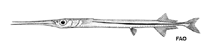
Etymology: Platybelone: Greek, platys = flat + Greek, belone = needle; any fish with sharp pointed snout; also Pierre Belon, 1517-64, French zoologist born in Le Mans. Professor at the College de France, author of " La nature et diversité des poissons", 1551 (Ref. 45335).
More on author: Lesueur.
Taxonomic Remarks
The 4 subspecies were upraised at species rank, as provisionally accepted names, , until more works are conducted on P. argalus susbepcies to fix their status.
Umwelt: Milieu / Klimazone / Tiefenbereich / Verbreitungsgebiet
Ökologie
seewasser riff-verbunden; tiefenbereich 0 - ? m, usually 0 - 2 m (Ref. 40849). Subtropical; 37°N - 29°S, 98°W - 34°W
Western Atlantic: North Carolina, USA to Brazil (Ref. 7251), including the Bahamas, Gulf of Mexico, and Caribbean Sea.
Größe / Gewicht / Alter
Geschlechtsreife: Lm ? range ? - ? cm
Max length : 50.0 cm TL Männchen/unbestimmt; (Ref. 26340); common length : 35.0 cm TL Männchen/unbestimmt; (Ref. 5217)
Rückenflossenweichstrahlen (insgesamt) : 12 - 15; Afterflossenweichstrahlen: 17 - 20. Gill rakers present; caudal peduncle with a lateral keel, the lateral line passing ventral to it.
Body shape (shape guide): eel-like.
Occurs offshore; particularly abundant around islands (Ref. 5217); schools in sheltered parts of the reef (Ref. 48635). Feeds mainly on small fishes. Oviparous (Ref. 205). Eggs may be found attached to objects in the water by tendrils on the egg's surface (Ref. 205).
Lebenszyklus und Paarungsverhalten
Geschlechtsreife | Fortpflanzung | Ablaichen | Eier | Fruchtbarkeit | Larven
Böhlke, J.E. and C.C.G. Chaplin, 1993. Fishes of the Bahamas and adjacent tropical waters. 2nd edition. University of Texas Press, Austin. (Ref. 5521)
IUCN Rote Liste Status (Ref. 130435: Version 2025-2 (Global))
Bedrohung für Menschen
Harmless
Nutzung durch Menschen
Fischereien: kleinfischerei
Tools
Zusatzinformationen
Download XML
Internet Quellen
Schätzungen auf der Grundlage von Modellen
Bevorzugte Temperatur (Ref.
123201): 25.1 - 28.2, mean 27.4 °C (based on 619 cells).
Phylogenetischer Diversitätsindex (Ref.
82804): PD
50 = 0.5078 [Uniqueness, from 0.5 = low to 2.0 = high].
Bayesian length-weight: a=0.00112 (0.00044 - 0.00287), b=3.05 (2.82 - 3.28), in cm total length, based on LWR estimates for this (Sub)family-body shape (Ref.
93245).
Trophische Ebene (Ref.
69278): 4.5 ±0.8 se; based on diet studies.
Widerstandsfähigkeit (Ref.
120179): hoch, Verdopplung der Population dauert weniger als 15 Monate. (Preliminary K or Fecundity.).
Anfälligkeit der Fischerei (Ref.
59153): Moderate vulnerability (40 of 100).
🛈
Nährstoffe (Ref.
124155): Calcium = 57.9 [15.1, 228.9] mg/100g; Iron = 0.551 [0.229, 1.539] mg/100g; Protein = 18 [16, 20] %; Omega3 = 0.162 [0.062, 0.487] g/100g; Selenium = 8.69 [3.39, 25.46] μg/100g; VitaminA = 117 [28, 555] μg/100g; Zinc = 0.654 [0.361, 1.155] mg/100g (wet weight);