>
Scombriformes (Mackerels) >
Scombridae (Mackerels, tunas, bonitos) > Scombrinae
Etymology: Euthynnus: Greek, eu = good + Greek, thynnos = tunna (Ref. 45335).
Ambiente: milieu / zona climatica / distribuzione batimetrica / gamma di distribuzione
Ecologia
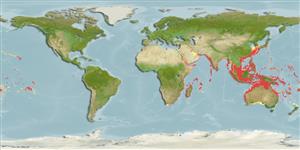
marino pelagic-neritic; oceanodromo (Ref. 71039); distribuzione batimetrica 0 - 200 m (Ref. 54439). Tropical; 18°C - 29°C (Ref. 168); 35°N - 38°S, 19°E - 137°W (Ref. 54439)
Indo-West Pacific: in warm waters including oceanic islands and archipelagos. A few stray specimens have been collected in the Eastern Central Pacific. Highly migratory.
Lunghezza alla prima maturità / Dimensione / Peso / Età
Maturità: Lm 42.3, range 40 - 65 cm
Max length : 100.0 cm FL maschio/sesso non determinato; (Ref. 168); common length : 60.0 cm FL maschio/sesso non determinato; (Ref. 168); peso massimo pubblicato: 14.0 kg (Ref. 30874); Età massima riportata: 6 anni (Ref. 121508)
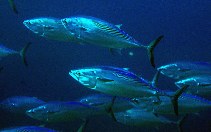
Spine dorsali (totale) : 10 - 15; Raggi dorsali molli (totale) : 11 - 15; Spine anali: 0; Raggi anali molli: 11 - 15; Vertebre: 39. This species is distinguished by the following characters: medium-sized fish with a robust, elongate and fusiform body; teeth small and conical, in a single series; total gill rakers on first gill arch 29-34; D1 XI-XIV with both dorsal fins separated by only a narrow interspace (not wider than eye), anterior spines of first fin much higher than those midway, giving fin a strongly concave outline; D2 much lower than first and followed by 8-10 finlets; anal fin followed by 6-8 finlets; pectoral fins short, never reaching interspace between dorsal fins; 2 flaps (interpelvic process) between pelvic fins; very slender caudal peduncle with a prominent lateral keel between 2 small keels at base of caudal fin; body naked except for corselet and lateral line. Colour of back dark blue with a complicated striped pattern which does not extend forward beyond middle of first dorsal fin; lower sides and belly silvery white; several characteristic dark spots between pelvic and pectoral fins (but may not always be present) (Ref. 9684, 90102).
Body shape (shape guide): fusiform / normal; Cross section: oval.
Occurs in open waters but always remains close to the shoreline. The young may enter bays and harbors. Forms multi-species schools by size with other scombrid species comprising from 100 to over 5,000 individuals. A highly opportunistic predator feeding indiscriminately on small fishes, especially on clupeoids and atherinids; also on squids, crustaceans and zooplankton. Caught in multispecies fisheries, mainly by surface trolling; also with gill nets. Generally marketed canned and frozen; also utilized dried, salted, smoked and fresh (Ref. 9684).
Collette, B.B. and C.E. Nauen, 1983. FAO Species Catalogue. Vol. 2. Scombrids of the world. An annotated and illustrated catalogue of tunas, mackerels, bonitos and related species known to date. Rome: FAO. FAO Fish. Synop. 125(2):137 p. (Ref. 168)
Stato della Lista Rossa IUCN (Ref. 130435: Version 2025-2 (Global))
Minaccia per l'uomo
Reports of ciguatera poisoning (Ref. 30911)
Usi umani
Pesca: elevato interesse commerciale; Pesce da pesca sportiva: si
Strumenti
Rapporti speciali
Scarica XML
Fonti Internet
Stime basate su modelli
Temperatura preferita (Fonte Biblio.
123201): 20.7 - 28.5, mean 26.9 °C (based on 1384 cells).
Indice di diversità filogenetica (Fonte Biblio.
82804): PD
50 = 0.6250 [Uniqueness, from 0.5 = low to 2.0 = high].
Bayesian length-weight: a=0.00977 (0.00846 - 0.01129), b=3.05 (3.01 - 3.09), in cm total length, based on LWR estimates for this species (Ref.
93245).
Livello trofico (Fonte Biblio.
69278): 4.5 ±0.0 se; based on diet studies.
Generation time: 1.6 (1.2 - 2.5) years. Estimated as median ln(3)/K based on 11
growth studies.
Resilienza (Fonte Biblio.
120179): Medio, tempo minimo di raddoppiamento della popolazione 1.4 - 4.4 anni (K=0.60; tm>2; tmax=6).
Prior r = 0.88, 95% CL = 0.58 - 1.32, Based on 5 full stock assessments.
Vulnerabilità della pesca (Ref.
59153): Moderate vulnerability (36 of 100).
🛈
Vulnerabilità climatica (Ref.
125649): High to very high vulnerability (75 of 100).
🛈
Nutrienti (Ref.
124155): Calcium = 20.9 [9.6, 171.3] mg/100g; Iron = 2.28 [0.88, 5.97] mg/100g; Protein = 23.1 [21.1, 24.7] %; Omega3 = 0.235 [0.129, 0.428] g/100g; Selenium = 70.6 [35.4, 143.5] μg/100g; VitaminA = 20.2 [5.4, 77.8] μg/100g; Zinc = 0.408 [0.211, 1.643] mg/100g (wet weight); based on
nutrient studies.