>
Siluriformes (Catfishes) >
Mochokidae (Squeakers or upside-down catfishes) > Mochokinae
Etymology: Synodontis: Greek, syn, symphysis = grown together + Greek, odous = teeth (Ref. 45335).
More on author: Boulenger.
Ambiente: milieu / zona climática / intervalo de profundidade / gama de distribuição
Ecologia
; Água doce bentopelágico; dH range: 15 - 35. Tropical; 21°C - 25°C (Ref. 2060); 3°S - 9°S
Tamanho / Peso / Idade
Maturidade: Lm ? range ? - ? cm
Max length : 27.5 cm TL macho/indeterminado; (Ref. 3202)
Descrição breve
Chaves de identificação | Morfologia | Morfometria
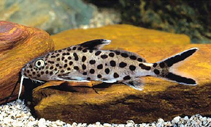
Espinhos dorsais (total) : 2; Raios dorsais moles (total) : 7; Espinhos anais: 0; Raios anais moles: 9 - 12. Axillary pore present; mandibular teeth 13-29; body with large spots; fin spines dark; 8 pectoral-fin rays; black triangles at base of pelvic and anal fins absent or poorly developed; eye 44.9-62.0% snout length; premaxillary toothpad uninterrupted; secondary branches on medial mandibular barbel absent; occipito-nuchal shield usually covered with skin; papillae on skin of body absent; hindgut chamber absent (Ref. 59365).
Body shape (shape guide): fusiform / normal.
Inhabits the muddy bottoms down to at least 100 m in lake (Ref. 4967). Feeds on the snail, Neothauma (Ref. 6770). Zoobenthos feeder (Ref. 52177). Oviparous (Ref. 205). Only fish known to practice brood parasitism: it manages to mix it eggs with those of mouthbrooding cichlids. Its larvae grow faster than those of the host and feed on them.
Ciclo de vida e comportamento de acasalamento
Maturidade | Reprodução | Desova | Ovos | Fecundidade | Larvas
Oviparous (Ref. 205). Distinct pairing during breeding (Ref. 205). Pairs manage to mix their eggs in the spawning nest of mouthbrooding cichlids, which take the eggs in the mouth together with their own. Its larvae grow faster than those of the host and feed on them.
Gosse, J.-P., 1986. Mochokidae. p. 105-152. In J. Daget, J.-P. Gosse and D.F.E. Thys van den Audenaerde (eds.) Check-list of the freshwater fishes of Africa (CLOFFA). ISNB, Brussels, MRAC, Tervuren; and ORSTOM, Paris. Vol. 2. (Ref. 3202)
Categoria na Lista Vermelha da IUCN (Ref. 130435: Version 2025-2 (Global))
Ameaça para o homem
Harmless
Utilização humana
Pescarias: pouco comercial
Ferramentas
Relatórios especiais
Descarregue XML
Fontes da internet
Estimativas baseadas em modelos
Índice de diversidade filogenética (Ref.
82804): PD
50 = 0.5000 [Uniqueness, from 0.5 = low to 2.0 = high].
Bayesian length-weight: a=0.01445 (0.00659 - 0.03170), b=2.90 (2.72 - 3.08), in cm total length, based on LWR estimates for this Genus-body shape (Ref.
93245).
Nível Trófico (Ref.
69278): 3.4 ±0.53 se; based on food items.
Resiliência (Ref.
120179): Elevada, tempo mínimo de duplicação da população menor que 15 meses (Preliminary K or Fecundity.).
Vulnerabilidade da pesca (Ref.
59153): Low vulnerability (18 of 100).
🛈