>
Siluriformes (Catfishes) >
Mochokidae (Squeakers or upside-down catfishes) > Mochokinae
Etymology: Synodontis: Greek, syn, symphysis = grown together + Greek, odous = teeth (Ref. 45335).
Eponymy: Dr William John Ansorge (1850–1913) was an English explorer and collector who was active in Africa in the second half of the 19th century. [...] (Ref. 128868), visit book page.
More on author: Boulenger.
Meio ambiente: milieu / Zona climática / intervalo de profundidade / faixa de distribuição
Ecologia
; Água doce bentopelágico. Tropical; 13°N - 7°N
Africa: basins of the Géba, Corubal, Kogon, Koumba, Kolenté/Great Scarcies, Rokel and Pampana/Jong in Guinea-Bissau, Guinea and Sierra Leone (Ref. 57223). Also reported from the Taja basin (Sierra Leone)(Ref. 3202) and the Konkouré (Guinea) and Sewa (Sierra Leone) rivers (Ref. 13331).
Tamanho / Peso / Idade
Maturidade: Lm ? range ? - ? cm
Max length : 22.3 cm SL macho/indeterminado; (Ref. 57223)
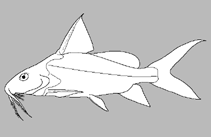
Espinhos dorsais (total) : 1; Espinhos anais: 0. Diagnosis: gill slits not extending ventrally beyond pectoral-fin insertions; post-orbital length at least 60% of snout length; maxillary barbels unbranched, longer than head, without tubercles and bordered by a black basal membrane; outer mandibular barbels with short and simple ramifications; branches of inner mandibular barbels subdivided/dichotomous but not tuberculate; mandibular teeth numbering 49-82 (64 in the lectotype); denticulations of pectoral-fin spines stronger on inner than on outer margin; dorsal-fin spine smooth anteriorly; only first branched dorsal-fin ray prolonged into a filament; humeral process triangular and granulose, deep, not keeled ventrally; adipose fin normally developed, truncate posteriorly and distinctly separated from rayed dorsal fin; eyes large (Ref. 57223).
Coloration: body entirely brownish (including ventral areas); numerous small black spots, particularly on head, but sometimes also on sides and fins (Ref. 57223).
Body shape (shape guide): fusiform / normal.
Maximum TL was recorded at 27.6 cm (Ref. 57223). Oviparous (Ref. 205).
Ciclo de vida ou comportamento de acasalamento
Maturidade | Reprodução | Desova | Ovos | Fecundidade | Larvas
Oviparous (Ref. 205). Distinct pairing during breeding (Ref. 205).
Paugy, D. and T.R. Roberts, 2003. Mochokidae. p. 195-268 In C. Lévêque, D. Paugy and G.G. Teugels (eds.) Faune des poissons d'eaux douce et saumâtres de l'Afrique de l'Ouest, Tome 2. Coll. Faune et Flore tropicales 40. Musée Royal de l'Afrique Centrale, Tervuren, Belgique, Museum National d'Histoire Naturalle, Paris, France and Institut de Recherche pour le Développement, Paris, France. 815 p. (Ref. 57223)
Status na Lista Vermelha da UICN (Ref. 130435: Version 2025-2 (Global))
Ameaça para os humanos
Harmless
Uso pelos humanos
Ferramentas
Relatórios especiais
Baixar XML
Fontes da internet
Estimativas baseadas em modelos
Índice de diversidade filogenética (Ref.
82804): PD
50 = 0.5000 [Uniqueness, from 0.5 = low to 2.0 = high].
Bayesian length-weight: a=0.01096 (0.00461 - 0.02608), b=3.00 (2.81 - 3.19), in cm total length, based on LWR estimates for this Genus-body shape (Ref.
93245).
Nível Trófico (Ref.
69278): 2.5 ±0.31 se; based on food items.
Resiliência (Ref.
120179): Elevada, tempo mínimo de duplicação da população menor que 15 meses (Preliminary K or Fecundity.).
Vulnerabilidade da pesca (Ref.
59153): Low vulnerability (17 of 100).
🛈