>
Siluriformes (Catfishes) >
Mochokidae (Squeakers or upside-down catfishes) > Mochokinae
Eponymy: Ian A Payne, who collected the catfish holotype, was a fisheries biologist at the Zoology Department, Fourah Bay College University of Sierra Leone, Freetown, Sierra Leone (1975) and at Department of Biological Sciences, Faculty of Applied Science, [...] (Ref. 128868), visit book page.
Umwelt: Milieu / Klimazone / Tiefenbereich / Verbreitungsgebiet
Ökologie
; süßwasser demersal. Tropical; 22°C - 24°C (Ref. 2060)
Africa: known only from the type locality in the Kasewe Forest Reserve (Jong/Pampana River basin), Sierra Leone (Ref. 57223).
Größe / Gewicht / Alter
Geschlechtsreife: Lm ? range ? - ? cm
Max length : 3.6 cm SL Männchen/unbestimmt; (Ref. 57223)
Kurzbeschreibung
Bestimmungsschlüssel | Morphologie | Morphometrie
Rückenflossenstacheln (insgesamt) : 1; Rückenflossenweichstrahlen (insgesamt) : 8; Afterflossenweichstrahlen: 10 - 11. Diagnosis: outer pair of mandibular barbels with 3, inner pair with 4, long and simple ramifications (Ref. 57223).
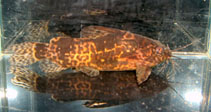
Coloration: colour pattern marbled; upper side of head dark with diffuse lighter cross-bars; black band between nostrils and eyes, another one ventrally between eyes and mouth; pale interorbital band; dark spots on cheeks and gill cover and dark brown area between dorsal-fin base and lateral line; below humeral process, this pigmentation forms a reticulate pattern; broad light bar behind adipose fin descending to posterior part of anal-fin base; caudal peduncle uniformly dark dorsally, ventrally pale behind anal fin, but becoming darker towards caudal fin; small dark spot at pelvic-fin bases; adipose fin dark, but white-edged posteriorly; all barbels striated (Ref. 57223).
Body shape (shape guide): fusiform / normal.
Lebenszyklus und Paarungsverhalten
Geschlechtsreife | Fortpflanzung | Ablaichen | Eier | Fruchtbarkeit | Larven
Oviparous (Ref. 205). Distinct pairing during breeding (Ref. 205).
Paugy, D. and T.R. Roberts, 2003. Mochokidae. p. 195-268 In C. Lévêque, D. Paugy and G.G. Teugels (eds.) Faune des poissons d'eaux douce et saumâtres de l'Afrique de l'Ouest, Tome 2. Coll. Faune et Flore tropicales 40. Musée Royal de l'Afrique Centrale, Tervuren, Belgique, Museum National d'Histoire Naturalle, Paris, France and Institut de Recherche pour le Développement, Paris, France. 815 p. (Ref. 57223)
IUCN Rote Liste Status (Ref. 130435: Version 2025-2 (Global))
Bedrohung für Menschen
Harmless
Nutzung durch Menschen
Tools
Zusatzinformationen
Download XML
Internet Quellen
Schätzungen auf der Grundlage von Modellen
Phylogenetischer Diversitätsindex (Ref.
82804): PD
50 = 1.0000 [Uniqueness, from 0.5 = low to 2.0 = high].
Bayesian length-weight: a=0.00871 (0.00368 - 0.02062), b=3.03 (2.83 - 3.23), in cm total length, based on LWR estimates for this (Sub)family-body shape (Ref.
93245).
Trophische Ebene (Ref.
69278): 3.0 ±0.4 se; based on size and trophs of closest relatives
Widerstandsfähigkeit (Ref.
120179): hoch, Verdopplung der Population dauert weniger als 15 Monate. (Preliminary K or Fecundity.).
Anfälligkeit der Fischerei (Ref.
59153): Low vulnerability (10 of 100).
🛈