>
Siluriformes (Catfishes) >
Mochokidae (Squeakers or upside-down catfishes) > Mochokinae
Etymology: Synodontis: Greek, syn, symphysis = grown together + Greek, odous = teeth (Ref. 45335).
Taxonomic Remarks
Reassigned to Synodontis based on a phylogenetic study by Vigliotta (2008: Ref. 79014). This species is placed in the genus Hemisynodontis in Eschmeyer (CofF ver. May 2011: Ref. 86870).
Окружающая среда: среда / климатическая зона / пределы глубины / диапазон распространения
экология
; пресноводный донно-пелагический; pH range: 6.8 - 7.2; dH range: ? - 25; мигрирует в реке (Ref. 138143). Tropical; 22°C - 25°C (Ref. 2060); 35°N - 4°N
Africa: Nile basin (Ref. 3202, 28714), Senegal, Gambia, Volta, Niger (including Benue) and Chad (Ref. 7362, 57223).
Длина при первой зрелости / Размер / Вес / Возраст
половая зрелость: Lm ?, range 25 - ? cm
Max length : 46.0 cm SL самец/пол неопределен; (Ref. 57223)
колючие лучи спинного плавника (общее число) : 1; колючие лучи анального плавника: 0. Diagnosis: gill slits extending downwards beyond pelvic-fin insertions to the midline of isthmus; maxillary barbels not longer than head, lacking tubercles and ramifications, but with a broad, black membrane extending over their entire length; mandibular barbels with a broad black membrane; outer and inner mandibular barbels with few and simple ramifications, and membranous at tips; mandibular teeth short, numbering 8-16; pectoral-fin spines more strongly denticulate on inner than on outer margin; dorsal-fin spine smooth, except for weak serrations present on posterior margin in some specimens; humeral process deep, short, granular and not keeled ventrally; adipose fin high, long and contiguous to rayed dorsal fin (Ref. 57223).
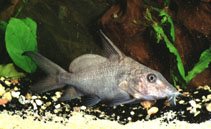
Coloration: typically inverted colour, the back being uniformly whitish-grey and the belly black; fins greyish, without spots; maxillary and mandibular barbels (particularly the outer pair) bordered by a broad, black membrane (Ref. 57223).
Body shape (shape guide): fusiform / normal.
Adults occur in deep water close to the shore. Omnivore, that feeds on plankton and detritus (Ref. 13868). May also feed on surface insects, chironomid larvae, benthic crustaceans, and mollusks (Ref. 28714). Oviparous (Ref. 205). Maximum size reported as 50.0cm (length type not given)(Ref. 31256).
Жизненный цикл и брачное поведение
половая зрелость | размножение | нерест | икра | Плодовитость | личинки
Oviparous (Ref. 205). Distinct pairing during breeding (Ref. 205).
Paugy, D. and T.R. Roberts, 2003. Mochokidae. p. 195-268 In C. Lévêque, D. Paugy and G.G. Teugels (eds.) Faune des poissons d'eaux douce et saumâtres de l'Afrique de l'Ouest, Tome 2. Coll. Faune et Flore tropicales 40. Musée Royal de l'Afrique Centrale, Tervuren, Belgique, Museum National d'Histoire Naturalle, Paris, France and Institut de Recherche pour le Développement, Paris, France. 815 p. (Ref. 57223)
Статус Красного Списка МСОП (Ref. 130435: Version 2025-2 (Global))
Угроза для людей
Harmless
Использование человеком
рыболовство: коммерческий
дополнительная информация
инструменты
Специальные отчеты
Скачать в формате XML
ресурсы в Интернет
Оценки, основанные на моделях
Индекс филогенетического разнообразия (ссылка
82804): PD
50 = 0.5000 [Uniqueness, from 0.5 = low to 2.0 = high].
Bayesian length-weight: a=0.01445 (0.00908 - 0.02301), b=2.93 (2.80 - 3.06), in cm total length, based on LWR estimates for this species & Genus-body shape (Ref.
93245).
Трофический уровень (ссылка
69278): 3.1 ±0.40 se; based on food items.
устойчивость к внешним воздействиям (ссылка
120179): средний (среднего размера), минимальное время удвоения популяции 1.4-4.4 года (K=0.14-0.55).
Уязвимость рыбной ловли (Ref.
59153): Low to moderate vulnerability (27 of 100).
🛈