>
Siluriformes (Catfishes) >
Ariidae (Sea catfishes) > Ariinae
Eponymy: Bloch did not identify whom he was naming this fish after, but a probable candidate is Count Ewald Friedrich von Herzberg (1725–1795), a distinguished Prussian statesman and savant and one of Bloch’s sponsors. (Ref. 128868), visit book page.
More on author: Bloch.
Milieu: milieu / Klimaatzone / Diepte / verspreidingsgebied
Ecologie
marien; zoet water; brak water demersaal. Tropical
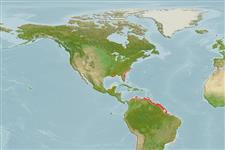
South America: Caribbean and Atlantic draining rivers and estuaries from Colombia to Brazil.
Lengte bij maturiteit / Grootte / Gewicht / Leeftijd
Maturiteit: Lm 50.8, range 45 - 56.5 cm
Max length : 94.2 cm TL mannelijk / geslacht onbekend; (Ref. 10652); 62.5 cm TL (female); common length : 30.0 cm TL mannelijk / geslacht onbekend; (Ref. 3265); max. gepubliceerd gewicht: 1.5 kg (Ref. 5217)
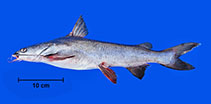
Body shape (shape guide): elongated; Cross section: circular.
Adults occur in turbid estuaries, mangrove-lined lagoons and lower parts of rivers being very tolerant to changes in salinity. Found on shallow soft bottoms (Ref. 5217). Feed on a large variety of bottom-living and pelagic organisms including those found among the roots of mangroves. Reproduction occurs between September and December. A female lays 20-30 eggs, with a diameter of 10-12 mm. Males incubate the eggs in their mouth (Ref. 35381).
Females reach maturity at a younger age than males and grow faster. The male incubates 28-40 eggs in the mouth and 200-400 eggs that are fixed in a glutinous mass on its head. Incubation takes 10-12 days. After 50-60 days fully functional young (6-6.5 cm TL) are released.
Chacon, J.O., M.I.M. Alves and M.S.C. de Mesquita, 1994. Alguns aspectos da reprodução do bagre branco, Selenapsis herzbergii (Bloch 1794), Pisces: Ostariophysi, Siluriformes, Ariidae. Bol. Tec. DNOCS. 47/52(1/2):43-78. (Ref. 10652)
Status op de Rode Lijst van het IUCN (Ref. 130435: Version 2025-2 (Global))
Gevaar voor de mens
Traumatogenic (Ref. 58010)
Gebruik door de mens
Visserij: van minder commercieel belang
Tools
Speciale rapporten
Download XML
Internetbronnen
Schattingen op basis van modellen
Gewenste temperatuur (Ref.
123201): 23.4 - 27.9, mean 25.6 °C (based on 428 cells).
Fylogenetische diversiteitsindex (Ref.
82804): PD
50 = 0.5078 [Uniqueness, from 0.5 = low to 2.0 = high].
Bayesian length-weight: a=0.00537 (0.00447 - 0.00645), b=3.15 (3.10 - 3.20), in cm total length, based on LWR estimates for this species (Ref.
93245).
Trofisch niveau (Ref.
69278): 3.3 ±0.39 se; based on food items.
Generation time: 3.8 ( na - na) years. Estimated as median ln(3)/K based on 1
growth studies.
Weerstandsvermogen (Ref.
120179): Gemiddeld, minimale populatieverdubbelingstijd 1,4-4,4 jaar (tm=2-3; Fec=200).
Kwetsbaarheid van de visserij (Ref.
59153): Moderate vulnerability (39 of 100).
🛈
Voedingsstoffen (Ref.
124155): Calcium = 93.2 [51.2, 182.5] mg/100g; Iron = 0.957 [0.621, 1.530] mg/100g; Protein = 16.8 [15.2, 18.5] %; Omega3 = 0.155 [0.087, 0.265] g/100g; Selenium = 75.6 [42.4, 141.5] μg/100g; VitaminA = 11 [5, 23] μg/100g; Zinc = 1.14 [0.79, 1.68] mg/100g (wet weight); based on
nutrient studies.