>
Siluriformes (Catfishes) >
Mochokidae (Squeakers or upside-down catfishes) > Chiloglanidinae
Etymology: Atopochilus: Greek atopos = absurde, strange + Greek, cheilos = lip (Ref. 45335).
Eponymy: Count Pierre Paul François Camille Savorgnan de Brazza (1852–1905) was the elder brother of Jacques (or Giacomo) C Savorgnan de Brazza. [...] (Ref. 128868), visit book page.
More on author: Sauvage.
Ambiente: milieu / zona climatica / distribuzione batimetrica / gamma di distribuzione
Ecologia
; acqua dolce demersale. Tropical; 3°N - 0°N
Africa: Ivindo, Ogooué, Nyanga and Louzibi Rivers in Gabon, the Rio Muni in Equatorial Guinea, and the Ntem River in southern Cameroon and Gabon (Ref. 81251).
Dimensione / Peso / Età
Maturità: Lm ? range ? - ? cm
Max length : 10.5 cm SL maschio/sesso non determinato; (Ref. 81251)
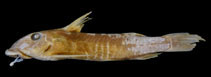
Spine dorsali (totale) : 1; Spine anali: 0; Raggi anali molli: 10 - 11; Vertebre: 32 - 33. Diagnosis: body depth slightly less than its greatest width; head depressed with a somewhat rugose upper surface; snout broadly rounded; nostril nearer end of snout than to eye; buccal cleft straight; mandibular tooth band less than half as long antero-posteriorly as premaxillary tooth band; maxillary barbel reaching to half of head length and at least twice as long as mandibular barbels; humeral process striated and acutely pointed; adipose fin almost 3 times as long as deep; anal fin with 10-11 rays, 1st and occasionally 2nd rays rudimentary; pectoral spine, strong, striated and strongly serrated along posterior margin; pelvic fin reaching almost to anal fin origin; caudal peduncle 1.5 times as long as deep (Ref. 81251).
Coloration: body mottled brown with small dark spots on sides and dorsal surface of body; 2 dark bands present on posterior half of body (1 between adipose and anal fin and 1 on caudal peduncle); pectoral fin darkly pigmented along base of fin rays; distal half of pelvic and anal fin rays lightly pigmented; caudal fin with 2 dark bands, 1 at base and another at tips of fin rays (Ref. 81251).
Body shape (shape guide): fusiform / normal.
Ciclo vitale e comportamento di accoppiamento
Maturità | Riproduzione | Deposizione | Uova | Fecondità | Larve
Oviparous (Ref. 205). Distinct pairing during breeding (Ref. 205).
Gosse, J.-P., 1986. Mochokidae. p. 105-152. In J. Daget, J.-P. Gosse and D.F.E. Thys van den Audenaerde (eds.) Check-list of the freshwater fishes of Africa (CLOFFA). ISNB, Brussels, MRAC, Tervuren; and ORSTOM, Paris. Vol. 2. (Ref. 3202)
Stato della Lista Rossa IUCN (Ref. 130435: Version 2025-2 (Global))
Minaccia per l'uomo
Harmless
Usi umani
Strumenti
Rapporti speciali
Scarica XML
Fonti Internet
Stime basate su modelli
Indice di diversità filogenetica (Fonte Biblio.
82804): PD
50 = 0.5078 [Uniqueness, from 0.5 = low to 2.0 = high].
Bayesian length-weight: a=0.00389 (0.00180 - 0.00842), b=3.12 (2.94 - 3.30), in cm total length, based on all LWR estimates for this body shape (Ref.
93245).
Livello trofico (Fonte Biblio.
69278): 3.2 ±0.4 se; based on size and trophs of closest relatives
Resilienza (Fonte Biblio.
120179): Alto, tempo minimo di raddoppiamento della popolazione meno di 15 mesi (Preliminary K or Fecundity.).
Vulnerabilità della pesca (Ref.
59153): Low vulnerability (10 of 100).
🛈