>
Siluriformes (Catfishes) >
Clariidae (Airbreathing catfishes)
Etymology: Tanganikallabes: Composed from lake Tanganyka + Greek, allabes, -etos = a fish of the Nile, a kind of lamprey (Ref. 45335).
Eponymy: T Mortiaux, a health worker in Albertville, Belgian Congo (Kalemie, Democratic Republic of the Congo), on the western shore of Lake Tanganyika, collected the holotype. (Ref. 128868), visit book page.
More on author: Poll.
Milieu: milieu / Klimaatzone / Diepte / verspreidingsgebied
Ecologie
; zoet water demersaal. Tropical; 3°S - 9°S
Africa: Lake Tanganyika (Ref. 90118).
Grootte / Gewicht / Leeftijd
Maturiteit: Lm ? range ? - ? cm
Max length : 32.5 cm TL mannelijk / geslacht onbekend; (Ref. 90118)
Korte beschrijving
Determinatiesleutels | Morfologie | Morfometrie
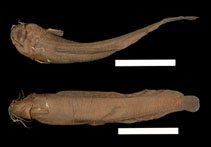
Dorsale stekels (totaal) : 0; Dorsale zachte stralen (totaal) : 72 - 83; Anale stekels: 0; Anale zachte stralen: 58 - 65. Diagnosis: Tanganikallabes mortiauxi is distinguished from its congeners by the morphology of the vomerine toothpad, which, at its widest point anteroposteriorly, is thicker than the premaxillary toothpad, vs. a uniformly thin, broad crescent in other Tanganikallabes species; the presence of a complete lateral line, vs. incomplete lateral line; free lower orbital margin, vs. no free margin; well-defined, thick basal membranes on the barbels, vs. thin membranes; and a larger eye, 1.8-3.0% of standard length vs. 0.8-1.6% in Tanganikallabes alboperca or 1.0-1.9% in T. stewarti (Ref. 90118). The cranial osteology of T. mortiauxi further separates this species from all congeners: in T. mortiauxi, io-iv consists of a single element, vs. two separate elements in T. alboperca and T. stewarti; similarly, the suprapreopercle of T. mortiauxi is composed of a single element, whereas that of T. alboperca and T. stewarti is composed of two, or sometimes three, elements; furthermore, the extensions of the lateral ethmoid nearly overlie io-ii when viewed from above, but are well separated in T. alboperca and T. stewarti (Ref. 90118). Tanganikallabes mortiauxi can also be distinguished from T. alboperca by having longer pelvic fins, 7.4-9.3% of standard length vs. 6.0-7.7%, that reach beyond the origin of the anal fin when adpressed; longer pectoral fin spines, 5.6-8.8% of standard length vs. 3.6-5.3; a higher number of dorsal fin rays, 72-81 vs. 65-74; and the lack of a depigmented opercular margin (Ref. 90118). Tanganikallabes mortiauxi is further separated from T. stewarti by its proportionally longer prepelvic length, 39.7-44.4% of standard length vs. 35.7-39.2%; its proportionally longer preanal length, 47.1-51.7% of standard length vs. 42.4-44.8%; and shorter anal fin, anal fin base 47.6-54.2% of standard length vs. 54.1-58.9% (Ref. 90118).
Body shape (shape guide): elongated.
Found in littoral to benthic zones over rocky bottoms; this species may inhabit rocky bottoms over a wide range of depths (Ref. 78218, 90118). It appears to be an opportunistic, generalist predator feeding on eggs of fish species, platythelphusid crabs, atyid shrimps and insect larvae (Ref. 90118).
Levenscyclus en paargedrag
Maturiteit | Voortplanting | Paaien | Eieren | Fecunditeit | Larven
Wright, J.J. and R.M. Bailey, 2012. Systematic revision of the formerly monotypic genus Tanganikallabes (Siluriformes: Clariidae). Zool. J. Linn. Soc. 165:121-142. (Ref. 90118)
Status op de Rode Lijst van het IUCN (Ref. 130435: Version 2025-2 (Global))
Gevaar voor de mens
Harmless
Gebruik door de mens
Tools
Speciale rapporten
Download XML
Internetbronnen
Schattingen op basis van modellen
Fylogenetische diversiteitsindex (Ref.
82804): PD
50 = 0.6250 [Uniqueness, from 0.5 = low to 2.0 = high].
Bayesian length-weight: a=0.00741 (0.00344 - 0.01597), b=2.97 (2.79 - 3.15), in cm total length, based on LWR estimates for this (Sub)family-body shape (Ref.
93245).
Trofisch niveau (Ref.
69278): 3.4 ±0.6 se; based on size and trophs of closest relatives
Weerstandsvermogen (Ref.
120179): Hoog, minimale populatieverdubbelingstijd minder dan 15 maanden (Preliminary K or Fecundity.).
Kwetsbaarheid van de visserij (Ref.
59153): Low vulnerability (23 of 100).
🛈