>
Siluriformes (Catfishes) >
Clariidae (Airbreathing catfishes)
Etymology: Gymnallabes: Greek, gymnos = hidden + Greek, allabes, -etos = a fish of the Nile, a kind of lamprey (Ref. 45335).
More on author: Günther.
Entorno: milieu / zona climática / rango de profundidad / gama de distribución
Ecología
; agua dulce demersal. Tropical; 17°N - 2°N
Africa: lower reaches and the delta of the Niger (Nigeria) and the Cross basin (Nigeria and Cameroon)(Ref. 57129, 81644). Also reported from the rivers Ouémé (Benin) (Ref. 57129, 81644) and Osse (Nigeria)(Ref. 57129).
Tamaño / Peso / Edad
Madurez: Lm ? range ? - ? cm
Max length : 29.7 cm TL macho / no sexado; (Ref. 81644)
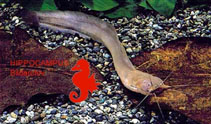
Espinas dorsales (total) : 0; Radios blandos dorsales (total) : 96 - 109; Espinas anales: 0; Radios blandos anales: 83 - 94. Diagnosis: dorsal and anal fins always confluent with caudal fin (Ref. 57129, 81644). Body very elongate, maximum body depth 14-15% standard length (Ref. 57129), abdominal depth 4.5-8% SL (mean 6) (Ref. 81644). Head very short, 12.5-14.3% standard length; lateral cephalic bones separated from each other by a distinct gap (Ref. 57129). Distance between supraoccipital process and dorsal fin short, 5-14% SL; pectoral fins present, 30-56% skull length, supported by a short spine (about half of fin length); pelvic fins always present and short; skull short, 11-18% SL (mean 13), with a very narrow roof, 9-23% (mean 14) head length, partially covered by jaw muscles; these muscles almost completely exposed dorsally and laterally and frequently bulging (especially in larger specimens); supraoccipital process short and narrow, 10-20% (mean 16) head length; eyes very small (4-9%), bordered by small infraorbital bones (hard to observe externally); barbels long, maxillary longest (86-155% skull
length); maxillary barbel connected at base to large skin folds that border mouth opening; when mouth is closed, these skin flaps are folded and conspicuous in dorsal view; internal mandibular barbel shortest, 58-99% (mean 76) head length (Ref. 81644).
Coloration: in life: uniformly light brown (Ref. 81644). Preserved specimens: brownish-black on back and sides, light brown on belly (Ref. 57129). Ventral prepelvic region slightly paler than rest of body (Ref. 81644).
Body shape (shape guide): eel-like.
Prefers small streams and ditches with leaf litter. Also found in swamp regions. Diet probably consists of insect larvae, worms and similar smaller organisms. Fishes are not eaten (Ref. 78218).
Ciclo vital y comportamiento de apareamiento
Madurez | Reproducción | Puesta | Huevos | Fecundidad | Larva
Teugels, G.G., 2003. Clariidae. p. 144-173 In C. Lévêque, D. Paugy and G.G. Teugels (eds.) Faune des poissons d'eaux douce et saumâtres de l'Afrique de l'Ouest, Tome 2. Coll. Faune et Flore tropicales 40. Musée Royal de l'Afrique Centrale, Tervuren, Belgique, Museum National d'Histoire Naturalle, Paris, France and Institut de Recherche pour le Développement, Paris, France. 815 p. (Ref. 57129)
Situación en la Lista Roja de la UICN (Ref. 130435: Version 2025-2 (Global))
Amenaza para el ser humano
Harmless
Usos humanos
Herramientas
Informes especiales
Descargar XML
Fuentes de Internet
Estimaciones basadas en modelos
Índice de diversidad filogenética (Referencia
82804): PD
50 = 0.7500 [Uniqueness, from 0.5 = low to 2.0 = high].
Bayesian length-weight: a=0.00102 (0.00046 - 0.00225), b=3.06 (2.88 - 3.24), in cm total length, based on all LWR estimates for this body shape (Ref.
93245).
Nivel trófico (Referencia
69278): 3.4 ±0.6 se; based on size and trophs of closest relatives
Resiliencia (Referencia
120179): Alto, población duplicada en un tiempo mínimo inferior a 15 meses (Preliminary K or Fecundity.).
Vulnerabilidad pesquera (Ref.
59153): Low vulnerability (20 of 100).
🛈