>
Siluriformes (Catfishes) >
Amphiliidae (Loach catfishes) > Doumeinae
Etymology: Doumea: Taken form a locality, Doumé, in Congo (Ref. 45335).
Eponymy: Dr Pierre-Alfred Chappuis (1891–1960) was a French-born Swiss zoologist, entomologist and bio-speleologist who specialized in isopods. [...] (Ref. 128868), visit book page.
More on author: Pellegrin.
Lingkungan: lingkungan / zona iklim / kisaran kedalaman / jangkauan distribusi
Ekologi
; air tawar dasar (demersal). Tropical; 14°N - 4°N
Africa: coastal river basins in Guinea, Liberia and Côte d’Ivoire (Ref. 85844). Also reported from the Corubal in Guinea Bissau (Ref. 85844).
Ukuran / Berat / umur
Kematangan: Lm ? range ? - ? cm
Max length : 11.6 cm SL jantan/; (Ref. 85844)
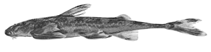
Duri punggung (Keseluruhan (total)) : 0; duri punggung lunak (Keseluruhan (total)) : 8; Duri dubur: 0; Sirip dubur lunak: 9 - 12. Diagnosis: Doumea chappuisi is distinguished from its congeners, except D. reidi and D. stilicauda, by having the dorsolateral and ventrolateral vertebral processes extending through the skin to form longitudinal bony ridges from the region of the base of adipose fin posteriorly to the caudal-fin base and from slightly posterior of the pelvic-fin origin to the caudal-fin base; exposed processes are in the shape of longitudinal bars with slightly corrugated surfaces that form irregular longitudinal ridges (Ref. 85844). It differs from D. reidi by a shorter caudal-peduncle length, 22-29% of standard length vs. 31%; the posterior extent of the adpressed pelvic fin in specimens over 90 mm standard length falling short of the anterior limit of the anal fin, vs. extending distinctly beyond that point; the anterior extent of the exposed vertebral processes along the ventral surface of the body extending to slightly posterior of pelvic-fin origin, vs. extending to the area lateral to the anal-fin base; and the uniform pigmentation pattern of the dorsal surface of the unbranched rays of the pectoral and pelvic fins, vs. with series of irregular dark spots against a lighter background (Ref. 85844). It differs from D. stilicauda in the longer predorsal length, 32-37% of standard length vs. 27-30%; longer head length, 18% of standard length vs. 15-17%; smaller caudal-peduncle length, 22-29% of standard length vs. 35-41%; and caudal-peduncle depth 7.3-14.5 times in caudal-peduncle length, vs. 19.6-25.8 times (Ref. 85844).
Body shape (shape guide): elongated.
Siklus hidup dan perilaku kawin
Kematangan | Reproduksi, perkembang biakan | Pemijahan | telur-telur | Fekunditas | Larva
Ferraris, C.J., P. Skelton and R.P. Vari, 2010. Species of the Doumea chappuisi complex (Siluriformes, Amphiliidae) with the descriptions of new species from the upper Sanaga River and Nyong River basins. Copeia 2010(4):705-715. (Ref. 85844)
Status IUCN Red List (Ref. 130435: Version 2025-2 (Global))
ancaman kepada manusia
Harmless
penggunaan manusia
Alat, peralatan
laporan khas
muat turun XML
Sumber internet
Estimasi berdasarkan model
Indeks keanekaragaman filogenetik (Acuan
82804): PD
50 = 0.5020 [Uniqueness, from 0.5 = low to 2.0 = high].
Bayesian length-weight: a=0.00389 (0.00180 - 0.00842), b=3.12 (2.94 - 3.30), in cm total length, based on all LWR estimates for this body shape (Ref.
93245).
Tingkat Trofik (Acuan
69278): 3.1 ±0.4 se; based on size and trophs of closest relatives
Daya lenting (Acuan
120179): sedang, Waktu penggandaan populasi minimum 1.4 - 4.4 tahun (Preliminary K or Fecundity.).
Kerentanan Penangkapan Ikan (Ref.
59153): Low vulnerability (10 of 100).
🛈