>
Siluriformes (Catfishes) >
Amphiliidae (Loach catfishes) > Leptoglaninae
Etymology: Leptoglanis: Greek,leptos = thin + Greek, glanis = a fish that can eat the bait without touching the hook; a cat fish (Ref. 45335).
More on author: Boulenger.
Ambiente: milieu / zona climatica / distribuzione batimetrica / gamma di distribuzione
Ecologia
; acqua dolce demersale. Tropical
Africa: Pool Malebo (= Stanley Pool)(Ref. 51287), middle Congo River main course (Ref. 106245), Aruwimi River (Ref. 51287, 106290) and Wagenia Falls (Ref. 51287, 106245) in Democratic Republic of the Congo, as well as the Ubangi in Democratic Republic of the Congo and Central African Republic (Ref. 51287).
Dimensione / Peso / Età
Maturità: Lm ? range ? - ? cm
Max length : 7.8 cm TL maschio/sesso non determinato; (Ref. 3236)
Breve descrizione
Chiavi di identificazione | Morfologia | Morfometria
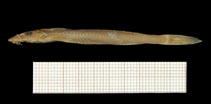
Vertebre: 38 - 41. Anterior margin of mouth with a single large medial fleshy lobe and several lateral fleshy lobes of variable size (Ref. 51287). Premaxillary with toothless anterior portion, posterior portion with slender conical teeth (Ref. 51287). Lower jaw toothless and exceptionally elongate (Ref. 51287). Coronomeckelian bone exceptionally large and well defined (Ref. 51287). Hyomandibular and quadrate joined by a complex joint consisting of a cartilaginous ball partially enclosed by bony sockets (Ref. 51287). An exceptionally short braincase (Ref. 51287). Pharynx and gill arches with numerous soft fleshy fingerlike or digitiform structures (Ref. 51287). Pectoral and pelvic fins excessively branched (Ref. 51287). Number of principal caudal fin rays: 7+8 (Ref. 51287). In life this species has a milk-white body, with fine, faint melanophores concentrated just above and below lateral line canal and in dorsal portions of myoseptal troughs (Ref. 51287). Two broad oblique bands on the dorsal fin, two broad vertical bands on the caudal fin and a single broad band in the middle of the pectoral fin, all composed of brownish melanophores (Ref. 51287); anal fin with a few fine melanophores on some rays, otherwise colorless (Ref. 51287); adipose and pelvic fins without notable color features (Ref. 51287).
Body shape (shape guide): elongated.
Ciclo vitale e comportamento di accoppiamento
Maturità | Riproduzione | Deposizione | Uova | Fecondità | Larve
Roberts, T.R., 2003. Systematics and osteology of Leptoglaninae a new subfamily of the African catfish family Amphiliidae, with descriptions of three new genera and six new species. Proc. Calif. Acad. Sci. 54(5):81-132. (Ref. 51287)
Stato della Lista Rossa IUCN (Ref. 130435: Version 2025-2 (Global))
Minaccia per l'uomo
Harmless
Usi umani
Strumenti
Rapporti speciali
Scarica XML
Fonti Internet
Stime basate su modelli
Indice di diversità filogenetica (Fonte Biblio.
82804): PD
50 = 0.7500 [Uniqueness, from 0.5 = low to 2.0 = high].
Bayesian length-weight: a=0.00389 (0.00180 - 0.00842), b=3.12 (2.94 - 3.30), in cm total length, based on all LWR estimates for this body shape (Ref.
93245).
Livello trofico (Fonte Biblio.
69278): 3.1 ±0.4 se; based on size and trophs of closest relatives
Resilienza (Fonte Biblio.
120179): Alto, tempo minimo di raddoppiamento della popolazione meno di 15 mesi (Preliminary K or Fecundity.).
Vulnerabilità della pesca (Ref.
59153): Low vulnerability (10 of 100).
🛈