>
Siluriformes (Catfishes) >
Bagridae (Bagrid catfishes)
Etymology: Bagrus: Mozarabic, bagre, taken from Greek, pagros = a fish (Dentex sp.) (Ref. 45335).
More on author: Boulenger.
Environnement : milieu / zone climatique / profondeur / gamme de distribution
Écologie
; eau douce démersal. Tropical; 3°N - 10°S
Africa: present throughout the Congo River basin (Ref. 2970, 42503, 44842, 51906, 106245, 106290), including the Dja in Cameroon, and the drainages of Kasai (Ref. 51686), Ubangi (Ref. 46252) and Pool Malebo (= Stanley Pool) (Ref. 42033, 51686) in Democratic Republic of the Congo.
Taille / Poids / Âge
Maturité: Lm ? range ? - ? cm
Max length : 31.5 cm TL mâle / non sexé; (Ref. 46901)
Description synthétique
Clés d'identification | Morphologie | Morphométrie
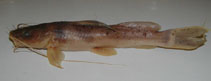
Épines dorsales (Total) : 1; Rayons mous dorsaux (Total) : 8 - 10; Rayons mous anaux: 9 - 12. Head smooth above (Ref. 1884, Ref. 2988). Sensory canals on head well developed (Ref. 1884). Snout broadly rounded (Ref. 2988). Palatine band of teeth about as large as band of premaxillary teeth (Ref. 1884, Ref. 2970), which is close to the crescentic band of vomerine teeth (Ref. 2988). Maxillary barbel 2.5-2.6 times longer than head (Ref. 2970), extending beyond root of pelvics (Ref. 2988). Nasal barbel 2 times in head length (Ref. 1884). Internal mandibular barbel 2.2-2.4 times in head length; external mandibular barbel 1-1.1 times in head length (Ref. 2970). Occipital processus very short, widely separated from the interneural bone (Ref. 42909, Ref. 46901). Length of dorsal fin base 1.6-1.8 times in base length of adipose fin (Ref. 2970). Dorsal spine present (Ref. 2988). First dorsal fin ray simple and soft (Ref. 2970). Last ray of dorsal fin above inner ray of pelvic fins (Ref. 2988). Distance between dorsal and adipose fin 2.5-2.6 times in base length of adipose fin; first 5 rays of anal fin simple and soft (Ref. 2970). Upper lobe of caudal fin with filament, less developed in lower lobe (Ref. 46901). Anterior side of pectoral spine not serrated (Ref. 2970), feebly denticulate on inner edge; pectoral spine strong (Ref. 2988). Pelvic fin a little shorter than pectoral fin (Ref. 1884). Some information on the caudal skeleton in Ref. 51975.
Coloration: back brownish, belly pale; small black spots on back, sides and partially on the adipose and caudal fin (Ref. 2970). A large blackish spot behind the shoulder may be present (Ref. 2988). The very long maxillary barbels are pale (Ref. 2970).
Body shape (shape guide): elongated.
Feeds on mud and small fishes (Ref. 51906). Can not be hooked (Ref. 51906). Mostly caught at night over muddy bottoms (Ref. 4910). Tasty when smoked (Ref. 51906). Lacks taste when raw and should be cooked with abundant red pepper (Ref. 51906).
Cycle de vie et comportement reproducteur
Maturité | Reproduction | Frai | Œufs | Fécondité | Larves
Ankei, Y., 1989. Folk knowledge of fish among the Songala and the Bwari: comparative ethnoichthology of the Lualaba River and Lake Tanganyika fishermen. Afr. Stud. Monogr. 9(Suppl.):1-88. (Ref. 51906)
Statut dans la liste rouge de l'IUCN (Ref. 130435: Version 2025-2 (Global))
Menace pour l'homme
Harmless
Utilisations par l'homme
Outils
Articles particuliers
Télécharger en XML
Sources Internet
Estimations basées sur des modèles
Indice de diversité phylogénétique (Réf.
82804): PD
50 = 0.5005 [Uniqueness, from 0.5 = low to 2.0 = high].
Bayesian length-weight: a=0.00871 (0.00415 - 0.01826), b=2.93 (2.76 - 3.10), in cm total length, based on LWR estimates for this (Sub)family-body shape (Ref.
93245).
Niveau trophique (Réf.
69278): 4.2 ±0.73 se; based on food items.
Résilience (Réf.
120179): Haut, temps minimum de doublement de population inférieur à 15 mois (Assuming Fec>10,000).
Vulnérabilité de la pêche (Ref.
59153): Low vulnerability (22 of 100).
🛈