>
Siluriformes (Catfishes) >
Bagridae (Bagrid catfishes)
Etymology: Bagrus: Mozarabic, bagre, taken from Greek, pagros = a fish (Dentex sp.) (Ref. 45335).
Eponymy: Edward J E Degen (1852–1922) was a Swiss naturalist and ornithologist who lived and worked in Australia, Africa and England; he died in London. [...] (Ref. 128868), visit book page.
More on author: Boulenger.
Environnement : milieu / zone climatique / profondeur / gamme de distribution
Écologie
; eau douce démersal. Tropical; 1°N - 3°S
Africa: endemic to Lake Victoria (Ref. 51686, 58032).
Taille / Poids / Âge
Maturité: Lm ? range ? - ? cm
Max length : 55.0 cm TL mâle / non sexé; (Ref. 52118)
Description synthétique
Clés d'identification | Morphologie | Morphométrie
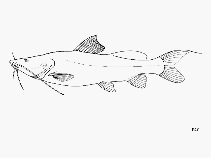
Épines dorsales (Total) : 1; Rayons mous dorsaux (Total) : 9; Rayons mous anaux: 12 - 13. Head much depressed, smooth above; long and narrow occipital processus, narrowly separated from interneural bone; snout broadly rounded, projecting beyond lower jaw (Ref. 2988). Eye iris dark, with a vivid yellow ring (Ref. 1568). Premaxillary band of teeth 6-7 times as long as broad, shorter than and as broad as or a little narrower than the vomerine band; maxillary barbel 1.25-2.33 times head length, extending to end of pectoral fin or a little beyond in adult, to end of ventral in young; nasal barbel 1/7(adult)-1/3 of head length; outer mandibular barbel 1.5-1.83 times length of inner and 0.5-1 times head length; gill-rakers rather long, widely set; dorsal spine smooth, less than 0.5 times head length; longest soft ray of dorsal fin 0.5-0.75 head length; adipose fin 4-5.5 times as long as deep, 1.5-1.66 times as long as dorsal fin; distance between dorsal and adipose fin 0.5-0.66 times dorsal fin length; pectoral spine not serrated in adult; caudal fin deeply forked, upper lobe with long filament (Ref. 2988).
Coloration: species blackish brown or dark steel-blue above, whitish or brassy yellow beneath with grey to blackish fins (Ref. 2988). Dark, nearly black on the back, fading into silver on the body, tinged with yellow (Ref. 36900).
Body shape (shape guide): elongated.
Caught in reeds and papyrus; feeds on small fish; grows up to 30-40 pounds (= 13-18kg); flesh is good and fish is of high economic importance (Ref. 36900).
Cycle de vie et comportement reproducteur
Maturité | Reproduction | Frai | Œufs | Fécondité | Larves
Jayaram, K.C., 1966. Contributions to the study of the fishes of the family bagridae. A systematic account of the African genera with a new classification of the family. Bull. I.F.A.N. (A) 28(3):1064-1139. (Ref. 51686)
Statut dans la liste rouge de l'IUCN (Ref. 130435: Version 2025-2 (Global))
Menace pour l'homme
Harmless
Utilisations par l'homme
Pêcheries: commercial
Outils
Articles particuliers
Télécharger en XML
Sources Internet
Estimations basées sur des modèles
Indice de diversité phylogénétique (Réf.
82804): PD
50 = 0.5005 [Uniqueness, from 0.5 = low to 2.0 = high].
Bayesian length-weight: a=0.00871 (0.00415 - 0.01826), b=2.93 (2.76 - 3.10), in cm total length, based on LWR estimates for this (Sub)family-body shape (Ref.
93245).
Niveau trophique (Réf.
69278): 4.2 ±0.73 se; based on food items.
Résilience (Réf.
120179): Haut, temps minimum de doublement de population inférieur à 15 mois (Assuming Fec>10,000).
Vulnérabilité de la pêche (Ref.
59153): Moderate vulnerability (42 of 100).
🛈