>
Ovalentaria/misc (Various families in series Ovalentaria) >
Pomacentridae (Damselfishes) > Chrominae
Etymology: Dascyllus: Greek, daskillys, -on = a kind of fish (Ref. 45335).
Eponymy: Donald W Strasburg (1925–2008) was a fish ecologist at the University of Hawaii and at the Bureau of Commercial Fisheries Biological Laboratory, Honolulu and an environmentalist at the Naval Research Laboratory, Washington, DC. [...] (Ref. 128868), visit book page.
Ambiente: milieu / zona climática / intervalo de profundidade / gama de distribuição
Ecologia
marinhas associadas(os) a recifes; não migratória; intervalo de profundidade 5 - 15 m (Ref. 7247). Tropical; 5°S - 10°S
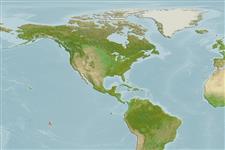
Eastern Central Pacific: endemic to the Marquesas Islands.
Tamanho / Peso / Idade
Maturidade: Lm ? range ? - ? cm
Max length : 9.0 cm SL macho/indeterminado; (Ref. 7247)
Descrição breve
Chaves de identificação | Morfologia | Morfometria
Espinhos dorsais (total) : 12; Raios dorsais moles (total) : 15 - 16; Espinhos anais: 2; Raios anais moles: 14 - 15.
Body shape (shape guide): short and / or deep; Cross section: compressed.
Adults inhabit coral and rocky reefs. The two specimens at the Bishop Museum were collected off Matahumu Point, Patu Hiva, Marquesas Islands in 6 to 12 meters (Ref. 7247). Feeds on zooplanktons (Ref. 89972). Life history characteristics for the family specify that this group is oviparous, with distinct pairing during breeding (Ref. 205). Eggs are demersal and adhere to the substrate (Ref. 205). Males guard and aerate the eggs (Ref. 205). Diurnal species (Ref. 54980; 113699).
Ciclo de vida e comportamento de acasalamento
Maturidade | Reprodução | Desova | Ovos | Fecundidade | Larvas
Life history characteristics for the family specify that this group is oviparous, with distinct pairing during breeding (Ref. 205). Eggs are demersal and adhere to the substrate (Ref. 205). Males guard and aerate the eggs (Ref. 205).
Allen, G.R., 1991. Damselfishes of the world. Mergus Publishers, Melle, Germany. 271 p. (Ref. 7247)
Categoria na Lista Vermelha da IUCN (Ref. 130435: Version 2025-2 (Global))
Ameaça para o homem
Harmless
Utilização humana
Ferramentas
Relatórios especiais
Descarregue XML
Fontes da internet
Estimativas baseadas em modelos
Temperatura preferida (Ref.
123201): 27.9 - 28.1, mean 28.1 °C (based on 11 cells).
Índice de diversidade filogenética (Ref.
82804): PD
50 = 0.5005 [Uniqueness, from 0.5 = low to 2.0 = high].
Bayesian length-weight: a=0.02089 (0.00931 - 0.04686), b=2.98 (2.79 - 3.17), in cm total length, based on LWR estimates for this (Sub)family-body shape (Ref.
93245).
Nível Trófico (Ref.
69278): 3.0 ±0.2 se; based on size and trophs of closest relatives
Resiliência (Ref.
120179): Elevada, tempo mínimo de duplicação da população menor que 15 meses (Preliminary K or Fecundity.).
Vulnerabilidade da pesca (Ref.
59153): Low vulnerability (10 of 100).
🛈
Nutrientes (Ref.
124155): Calcium = 126 [61, 211] mg/100g; Iron = 0.875 [0.503, 1.482] mg/100g; Protein = 18.2 [16.9, 19.3] %; Omega3 = 0.113 [0.062, 0.198] g/100g; Selenium = 19 [9, 40] μg/100g; VitaminA = 168 [48, 587] μg/100g; Zinc = 1.65 [1.07, 2.46] mg/100g (wet weight);